What Division Athletics actually runs, and what to keep
At Division Athletics (DVSN) in Singapore, the strength class is a 14-week loop with three blocks: hypertrophy, then strength, then performance. A class is 60 minutes. Hypertrophy is the block that feels like stamina: more reps, shorter rests, you breathe. Strength is heavier and slower. Performance is the phase that is easy to forget the name of. It is speed. Same kinds of lifts, moved faster, with the load a bit lighter. It is not a third month of grinding heavier.1
They also run a separate conditioning class, 45 minutes, on its own 14-week clock: seven weeks they call in-season, built around fitness tests, then seven weeks off-season for skills and variety. A third option, hybrid, is strength, then a skill, then a short conditioning finisher.1 A visitor write-up also describes an easy deload week inside the strength cycle. The public program page lists the three blocks and does not name that easy week.2
Steal the order: more reps, then heavier, then faster, then an easy week. Leave their weekly calendar. They split upper and lower across four days and add extra full-body days. You already run and play tennis. Two gym mornings is the dose that fits. Do not add their test workouts or a metcon finisher on top of a long run.
Their “in-season” is a conditioning-class label. Yours is different. A keep month is any month when the long run is building or tennis is the hard part of the week. In a keep month the gym holds what you have. It does not try to build. One hard session a week can hold strength for many weeks if the weight stays challenging. Two short sessions is the plan here, because the legs also have to run.34
Which version today
Tuesday is always session A. The second gym morning is session B, on the day that does not have tennis that evening. That week stays as written in the training calendar. This page only changes what happens inside the hour.
| Situation | Do this |
|---|
| Build month, Tuesday | Full session A for the block you are in |
| Build month, second gym day, no long run tomorrow | Full session B for that same block |
| Saturday is a long run | Short session B, even in a build month |
| Long-run build, or a heavy tennis month | Short A and short B all month. Hold the weights. |
| Week 12 | Easy week. Two sets, then leave. |
| Low back is doing the work | Stop the hinge. Keep the press or the row, and the carry. The mat work stays on the low-back page. |
The 12 weeks
Run this when running and tennis are the easier part of the week. Same two sessions every week. Only the reps, the rest, and the intent change. When you finish week 12, either start again at week 1 or switch the next month to the short hour if a race or a tennis block is coming.
| Weeks | Name | What it should feel like | Reps | Rest |
|---|
| 1–4 |
Stamina |
More reps. A pump. You breathe. This is their hypertrophy block. |
8–12 |
About 60–90 seconds |
| 5–8 |
Strength |
Heavier. Slower. The main lift is not paired with another hard move. |
4–6 |
About 2 minutes |
| 9–11 |
Speed |
Same lifts. Move them up fast. Weight comes down. If the bar slows, it is too heavy. |
3–5, fast up |
About 2 minutes |
| 12 |
Easy |
Half the sets. Leave by minute 30. The public DVSN page does not name this week. A visitor described one, and a short unload is the sensible end of a build. |
Stop early |
Normal |
How to add weight inside a block. The first numbers are in starting weights.
- Stamina: when you hit the top of the rep range and still have about two reps left, and the next morning is normal, add once. A bar goes up 2.5 kg. A dumbbell goes up one size, usually 2 kg per hand.
- Strength: start from the weight you finished stamina on. Add the same small jump only when five reps stop feeling hard.
- Speed: do not add weight. Use the load you used for sets of about ten. If the bar slows down, drop one jump. Chase a faster stand-up, not a new max.
- Keep month: do not add weight. The point is to keep the load you already earned.
The 4 / 4 / 3 / 1 split is an adaptation of their three public blocks plus an easy week. It is a sensible way to spend 12 weeks. It is not a claim that this exact split beat every other split in a trial. Indicated
Starting weights
You weigh 55 kg. In April 2025 the best conventional deadlift was 100 kg for one rep. The gym has not been consistent since then. Tennis and running have kept the legs working, so this is not a from-zero start. It is a long break from the barbell.
People who stop lifting lose strength, and the loss grows with time. The drop in the kind of strength you use for sets of 8 is clearer after about 8 weeks off. A one-rep max drops more clearly after about 16 weeks.8 Eighteen months is past both. The 100 kg number is a previous best. It is not a weight to put on the bar, and it is not a target for this 12-week cycle.
The Romanian deadlift is also a different lift. It is a slower hinge for several reps, and the low back stays under load longer than it does in one heavy conventional pull. Do not take half of 100 and call that the work set.
Use the numbers below for the first stamina session. Stop each set with about three reps left. If you hit the top of the range with reps still in the tank, and the next morning is normal, take one jump the next gym day. Never two jumps in one session. If the next morning is worse, repeat the same weight. Each move’s picture and cues are in how the moves look.
If the empty bar for 10 Romanian deadlift reps feels like a warm-up and the low back is quiet the next morning, the next gym day is 30 kg. After that, only +2.5 kg when the rule above is met. A place you might land by the end of the stamina month is somewhere around 40 kg. That is a checkpoint, not a goal.
On a machine press or machine row, pick the pin where 12 reps leave about three in reserve. Write that pin down. Add one pin on the same rule. If the gym’s smallest plate is 2.5 kg a side, a bar jump is 5 kg. Stay at the current weight for another week rather than taking a jump that big.
Warm-up, five minutes, every session
Same sequence in every block. Set a timer. When it hits five minutes, start the first work set.
- Long step into a lunge. Back knee can rest on the floor.
- Inside hand on the floor, beside the front foot.
- Elbow of that arm toward the instep. One breath. You should feel the front hip and the inner thigh, not a pinch in the knee.
- Hand back down. Rotate the chest open and reach the other arm up. One breath. Then stand and switch sides.
Hands slide down the thighs on the hinge, ribs stacked over the pelvis, same idea as the bodyweight hinge on the low-back page.
Light band, arms straight, squeeze the shoulder blades. No band at the gym: 10 slow arm circles each way.
Session A — squat, press, hinge, carry
First gym morning of the week. A superset here means one exercise, then the other, then rest. Pair a hard lift with a small move that does not load the same legs. Never pair the squat with the deadlift.
Stamina, weeks 1–4
| Clock | Work |
|---|
| 0–16 | Goblet squat, 4 × 8–10. Rest 90 seconds. Last set: about two reps left. |
| 16–30 | Dumbbell press, 3 × 8–12, superset with 12 band pull-aparts. Rest 60 seconds after the pair. |
| 30–42 | Romanian deadlift, 3 × 8–10. Rest 90 seconds. Ribs down. If the low back takes over, shorten the range. |
| 42–50 | Farmer carry, 4 walks of 20–30 m. Walk. Do not turn it into a run. |
Strength, weeks 5–8
| Clock | Work |
|---|
| 0–8 | Two light squat ramp-up sets. These count inside the 50 minutes. |
| 8–26 | Squat, 4 × 5. Rest about 2 minutes. Leave about two reps. |
| 26–40 | Press, 4 × 5. Rest about 2 minutes. Pull-aparts during the rest are fine. They are not a second workout. |
| 40–48 | Romanian deadlift, 3 × 5. Rest about 2 minutes. |
| 48–50 | One or two heavier farmer carries. Then leave. |
Speed, weeks 9–11
| Clock | Work |
|---|
| 0–6 | Two light squat ramps, stand up fast, sit down slow. |
| 6–24 | Squat, 4 × 3. Explode up, lower under control. Rest 2 minutes. No bounce out of the bottom. No jump if the low back has been sore. |
| 24–38 | Press, 4 × 3, fast up. Rest 2 minutes. |
| 38–48 | Romanian deadlift, 3 × 4. Snap the hips up. Do not bounce the weight off the floor. |
| 48–50 | One short carry. Leave. |
Session B — split squat, row, hinge, carry
Second gym morning. If that morning is Friday and Saturday is a long run, skip this full version and use the short hour.
Stamina, weeks 1–4
Strength, weeks 5–8
| Clock | Work |
|---|
| 0–8 | Two light split-squat ramps each leg. |
| 8–26 | Split squat, 4 × 5 each leg. Rest about 90 seconds between legs, and a full 2 minutes before you start the next round if the legs are cooked. Drop to 3 × 5 if you cannot hit both legs inside this window. |
| 26–40 | Row, 4 × 5. Rest about 2 minutes. |
| 40–48 | Back extension or single-leg Romanian deadlift, 3 × 6. |
| 48–50 | Suitcase carry, one walk each side. Leave. |
Speed, weeks 9–11
| Clock | Work |
|---|
| 0–6 | Light split-squat ramps, stand up fast. |
| 6–24 | Split squat, 3 × 3 each leg. Lighter than the strength block. Fast up, quiet knee. |
| 24–38 | Row, 4 × 3, fast pull. Rest 2 minutes. |
| 38–48 | Light hinge, 3 × 4, snap up. Back extension is the fallback if a single-leg deadlift feels sloppy. |
| 48–50 | One suitcase carry each side. Leave. |
The short hour
Use this for a keep month, for week 12, and for any Friday before a Saturday long run. Same exercises as the strength block. Two work sets only. Keep the weight heavy enough that the last reps are honest, and stop with about three reps left. Expect to finish around 30–35 minutes, warm-up included. The empty time is recovery. Do not fill it.
Week 12 uses those same two sets, but stop at four reps even if you could do more.
In professional soccer players, one strength session a week for 12 in-season weeks held squat strength and sprint speed. Training only every other week did not.4 A review of the smallest dose that still holds strength found that, in younger adults, one session a week and even one hard set can be enough for many weeks, as long as the weight stays heavy. The same review says there is not enough data to treat that as a rule for athletes.3 In people who already lift, doing the work more often does not clearly build more strength over a couple of months.5 So two short days is enough to keep. It is not a reason to add a third day.
Rules that keep the hour from eating the week
- No gym on a morning that has tennis that evening.
- Two gym days. Never a third.
- Hard running and hard legs do not share a morning. Men who lift and do endurance work in the same program gain a bit less lower-body strength than men who only lift. The effect is small. The fix is the calendar you already have: gym in the morning, tennis at night, and a short Friday when Saturday is the long run.6
- The mat session on the low-back page stays. It is the 15-minute control work. It is not a substitute for this hour, and this hour is not a substitute for it.
- Ribs stay stacked over the pelvis on the squat and the hinge. Film one set from the side every few weeks.
- Muscle work can feel like a 3 out of 10 the next morning. If you are worse the next morning, that load was too much. Repeat the same weight.
- Stop and use the red-flag list on the low-back page for pain that spreads, numbness, weakness, or trouble with the bladder or bowel. This page is not a diagnosis.
The clocks are a plan so the hour ends. They are not a lab measurement. If a pair runs long, drop the last set of the carry or the last set of the hinge. Do not borrow time from tomorrow’s run.
How the moves look
Tap a name in the plan and you land here. The clocks stay short on purpose. Pictures are teaching drawings. Where a drawing is slightly off, the written cue wins. Coral is the pelvis. Teal is the low back or the ribs.
World’s greatest stretch
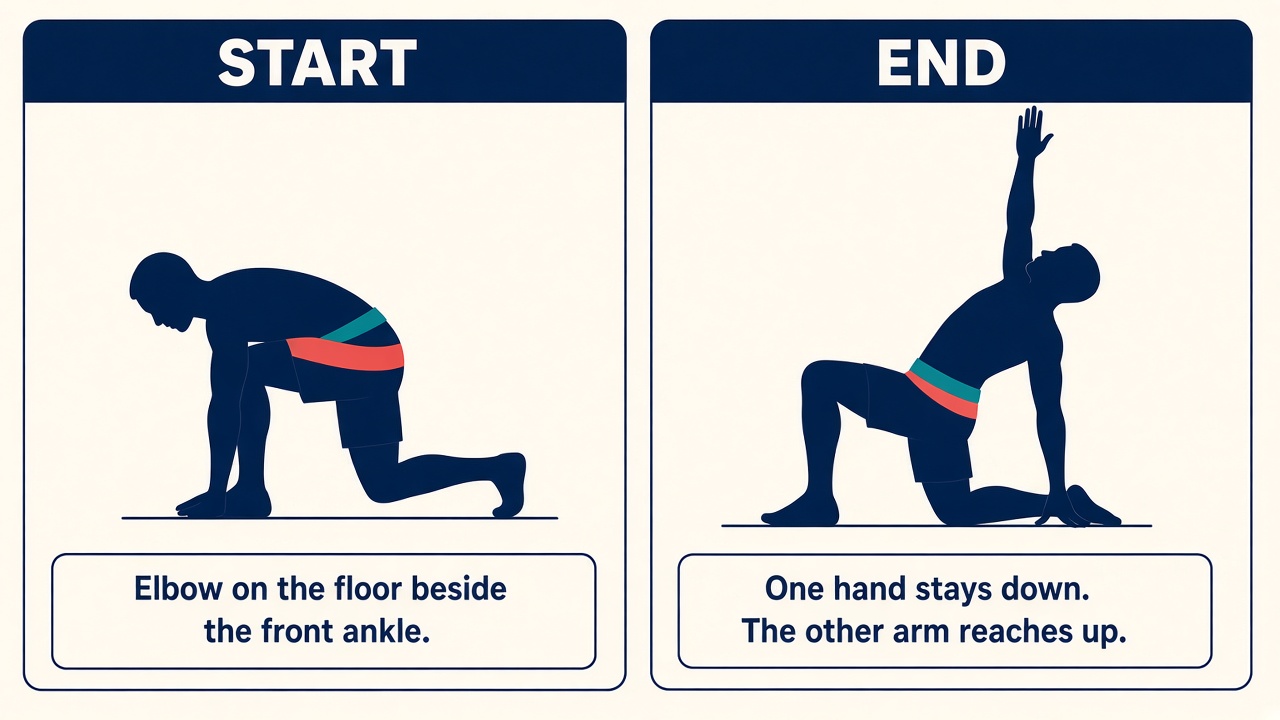
Elbow on the floor beside the front ankle, then one arm reaches up. The back knee stays down.
- Long step into a lunge. Back knee can rest.
- Inside elbow down by the front ankle. One breath. You should feel the front hip, not a pinch in the knee.
- Plant that hand. Reach the other arm up and open the chest. One breath. Switch sides.
Back to the warm-up
Goblet squat
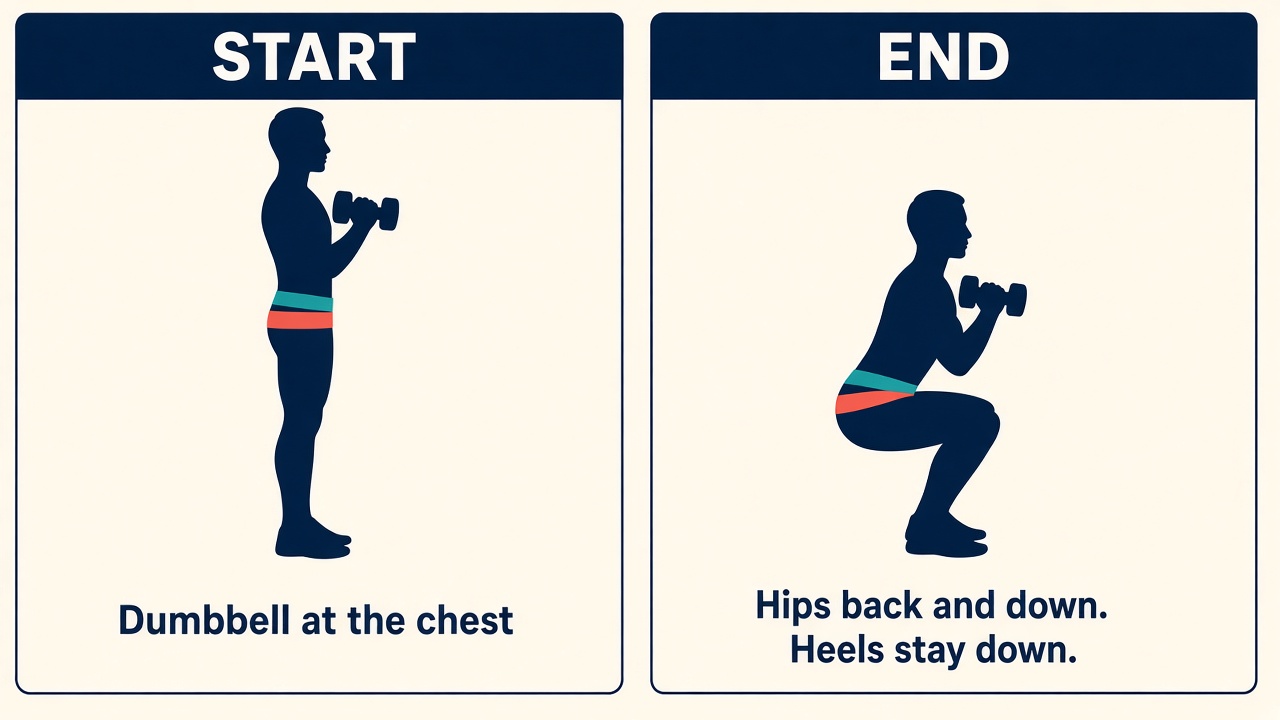
Safety-bar version: same shape, bar on the shoulders instead of a dumbbell at the chest. The warm-up squats are this shape with no weight.
- Dumbbell held at the chest. Feet about shoulder width. Ribs over the pelvis.
- Sit the hips back and down. Heels stay down. Knees track over the mid-foot.
- Stand up. Do not let the low back round, and do not finish in a big arch.
First session8 kg dumbbell, or an empty safety bar.
Add2 kg on the dumbbell, or 2.5 kg on the bar.
Back to session A
Dumbbell press
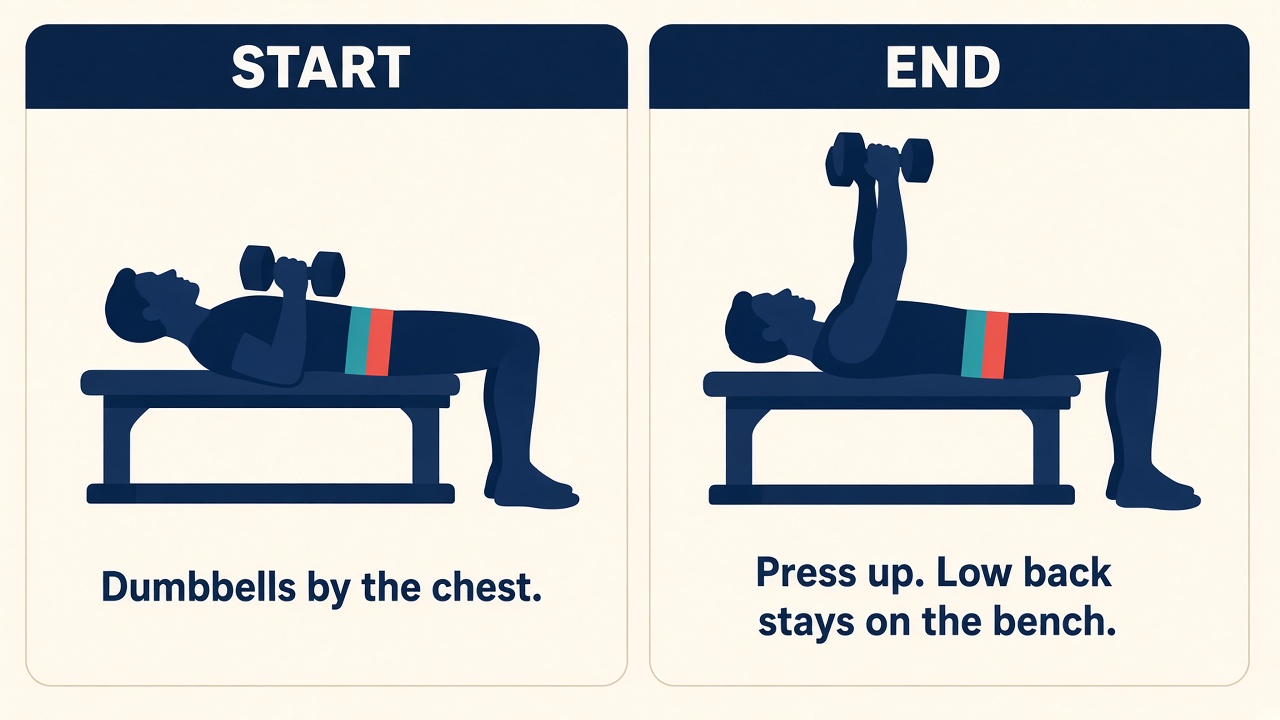
One dumbbell in each hand. A machine press is the same job if the bench is taken.
- Lie on the bench, feet on the floor, ribs down.
- Lower the dumbbells to the sides of the chest.
- Press up over the chest. Do not arch the low back off the bench to finish the rep.
First session4 kg each hand. On a machine, the pin where 12 reps leave about three in reserve.
Add2 kg each hand, or one machine pin.
Back to session A
Romanian deadlift
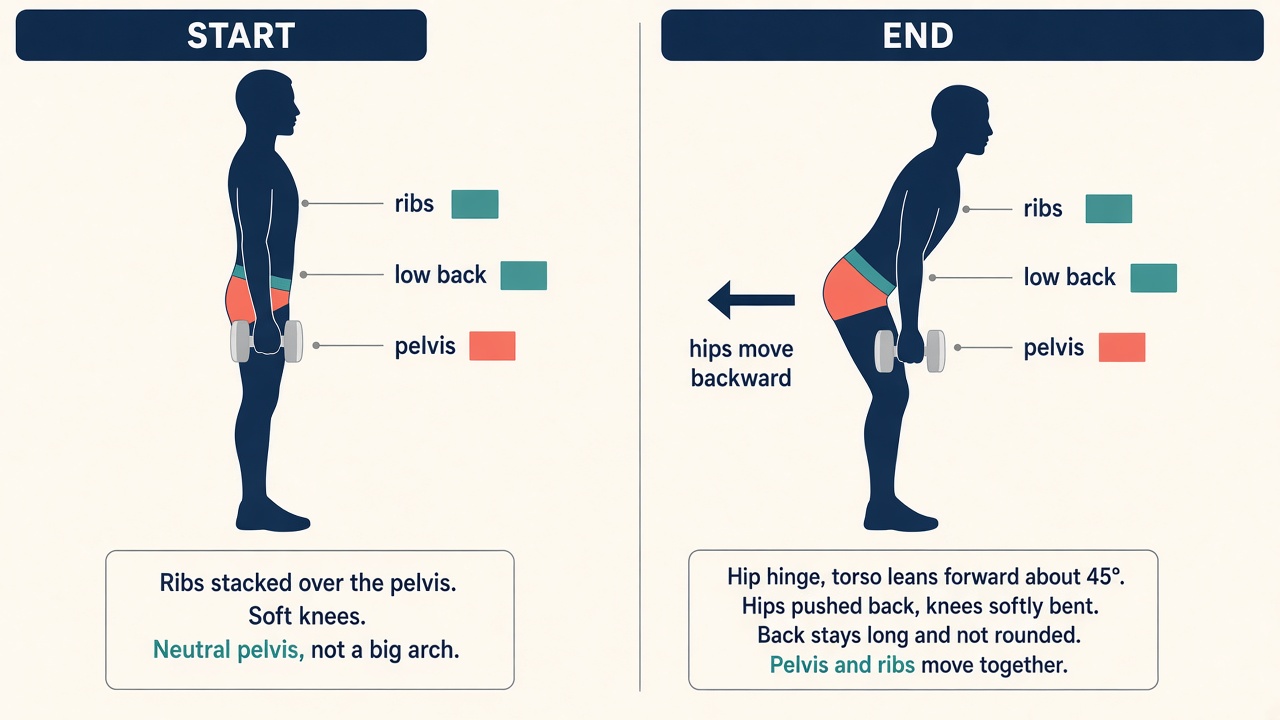
Same hinge as the low-back page. The empty bar is the gym version. This is not a conventional deadlift from the floor.
- Stand tall, soft knees, ribs over the pelvis. Bar in front of the thighs.
- Push the hips back. The bar stays close to the legs. Stop around mid-shin, or higher if the back starts to round.
- Stand by pushing the hips forward. Do not bounce the weight off the floor.
First sessionEmpty bar, 20 kg. Next gym day 30 kg only if 10 reps were easy and the back is quiet the next morning.
Add2.5 kg after that. The old 100 kg conventional max is not the load.
Back to session A
Farmer carry
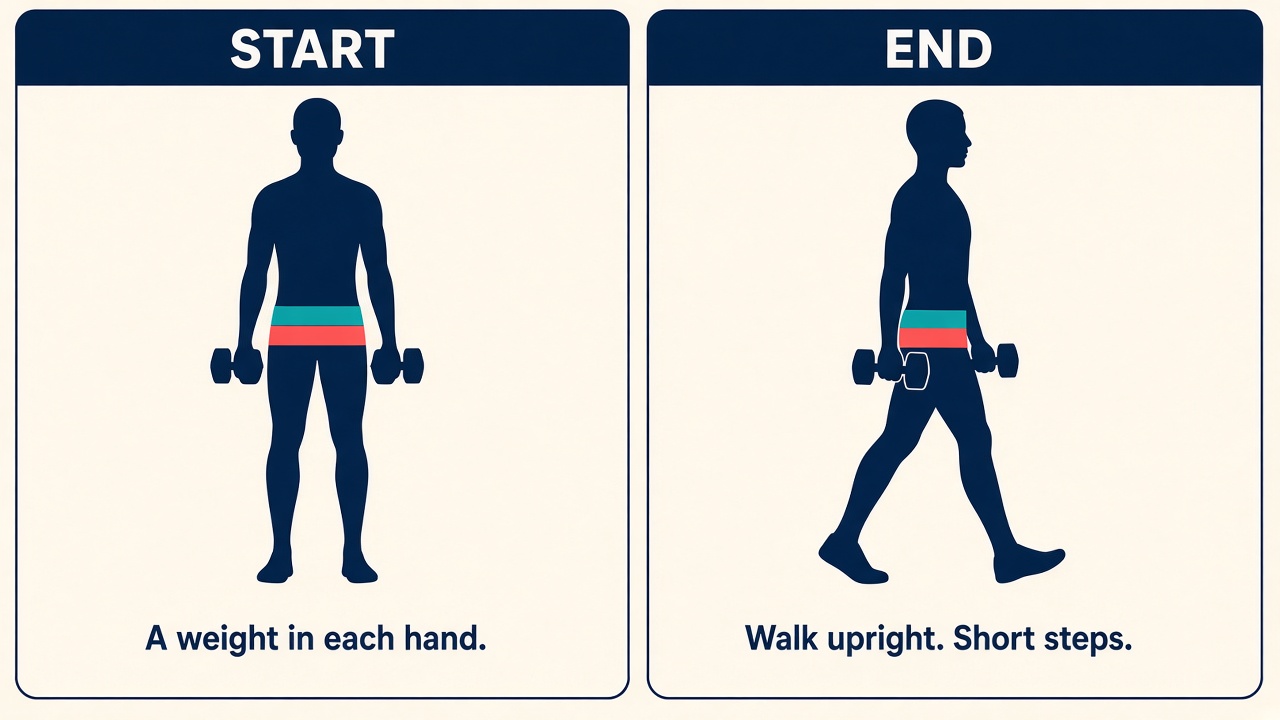
- A dumbbell in each hand. Shoulders down, away from the ears.
- Walk tall for 20–30 m. Short steps. Ribs stay over the pelvis.
- Put the weights down. Do not turn the walk into a run.
First session10 kg each hand.
Add2 kg each hand when the walk feels like a stroll.
Back to session A
Rear-foot split squat
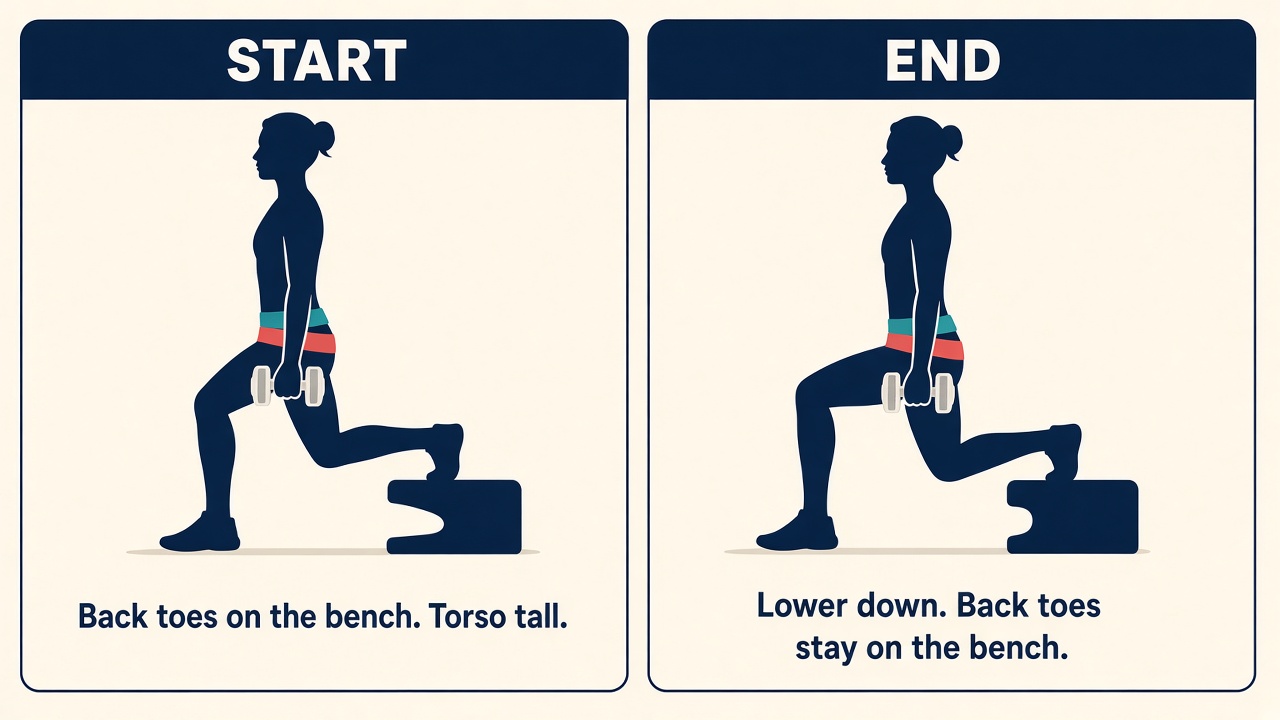
Back toes stay on the bench. Front knee travels over the mid-foot. Torso stays tall.
- Back toes on a low bench. Front foot far enough forward that the knee can bend over the mid-foot.
- Lower until the front thigh is about parallel. Torso stays tall. Hips stay square.
- Stand up through the front heel. Finish one leg, then switch.
First sessionBody weight. Add 4 kg each hand only when 8 each leg is easy and the knee is quiet.
Add2 kg each hand after that.
Back to session B
Chest-supported row
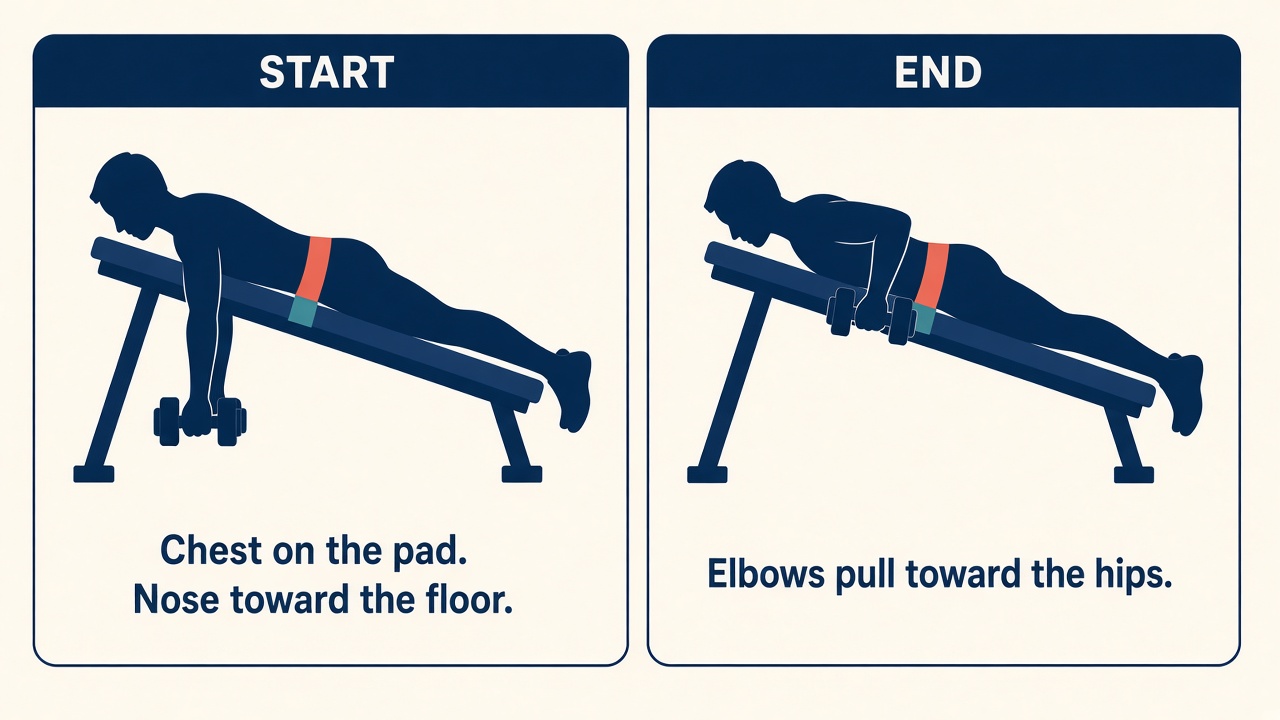
Chest on the pad, nose toward the floor. A cable row is fine if this bench is taken. Keep the chest supported so the low back does not do the pull.
- Chest on the pad. Arms hang with a dumbbell in each hand.
- Pull the elbows toward the hips. Squeeze the shoulder blades.
- Lower with control. The chest does not leave the pad.
First session8 kg each hand.
Add2 kg each hand.
Back to session B
Dead bug
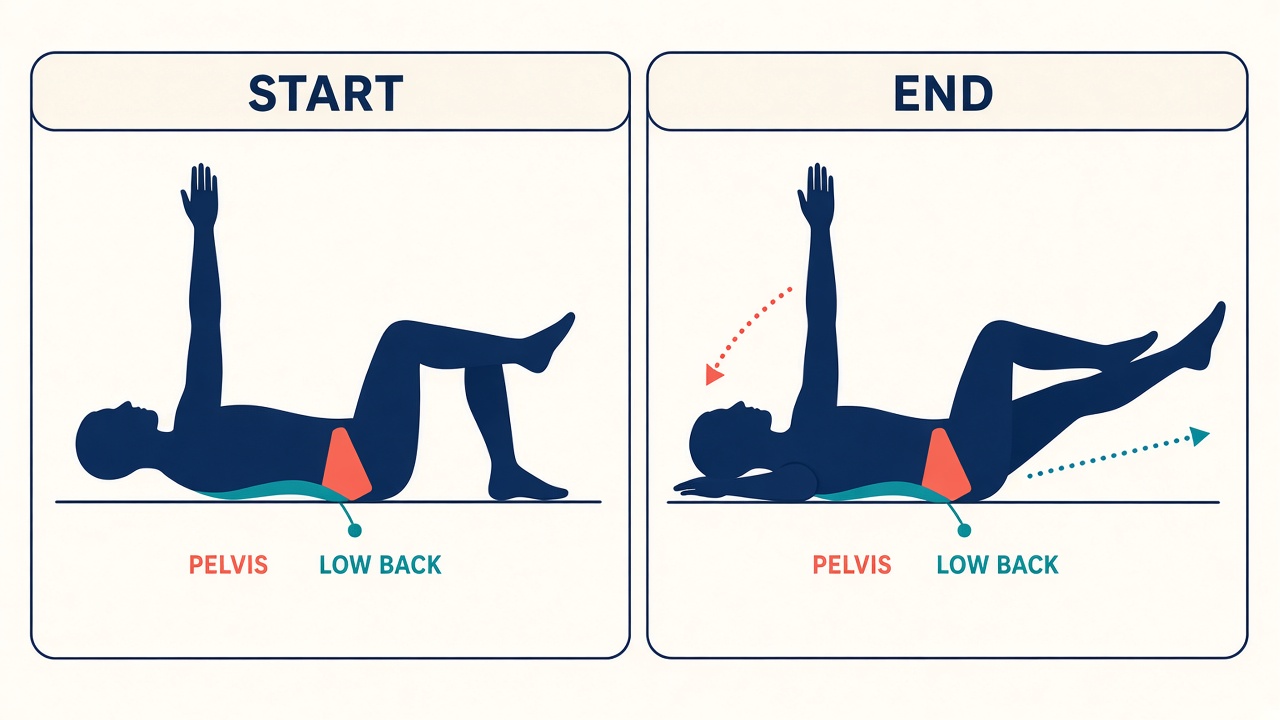
Full cues are on the low-back page. Here it is the easy pair with the row, not a heavy lift.
- On your back, ribs down, low back close to the floor.
- Reach the opposite arm and leg away. The low back does not arch off the floor.
- 6 each side, then the next row rep.
Back to session B
Back extension
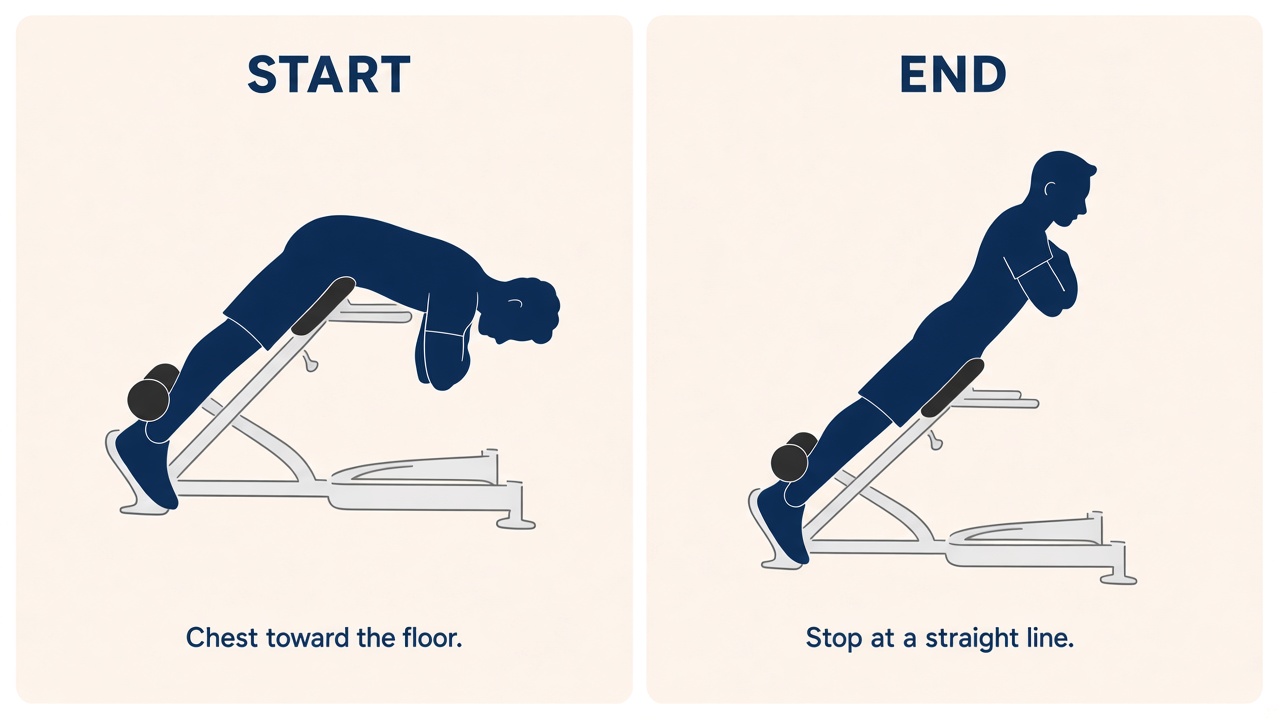
- Hips on the pad, feet anchored, hands across the chest.
- Hang down by hinging at the hips. Keep the spine long.
- Rise until the body is one straight line. Stop there. Do not sit up into an arch.
First sessionBody weight.
AddHug a 2.5 kg plate only when 8 reps reach the straight line easily.
Back to session B
Single-leg Romanian deadlift
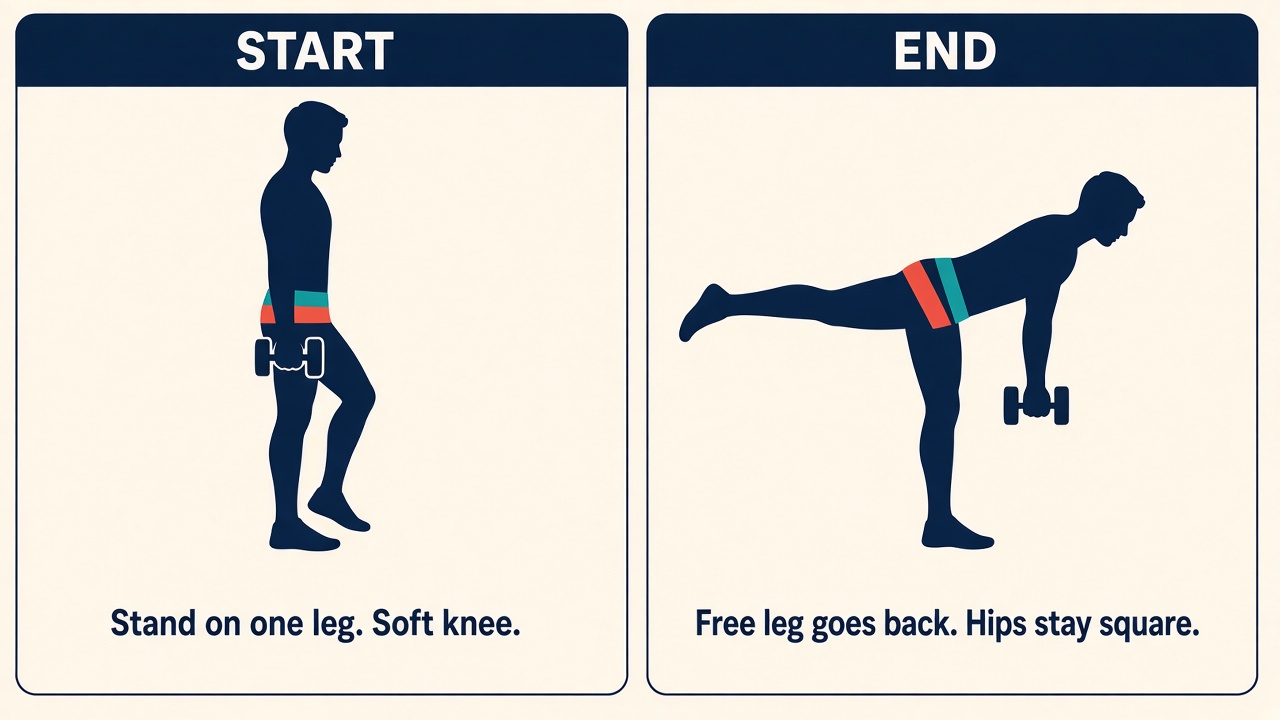
Coral is the pelvis. Teal is the low back. Hips stay square while the free leg goes back.
- Stand on one leg, soft knee. A light dumbbell can hang in the opposite hand.
- Hinge. The free leg goes back. Hips stay square. The low back stays long.
- Stand by pushing the hip forward. Switch legs.
First sessionBody weight. Then 4 kg in the opposite hand.
Add2 kg.
Back to session B
Suitcase carry
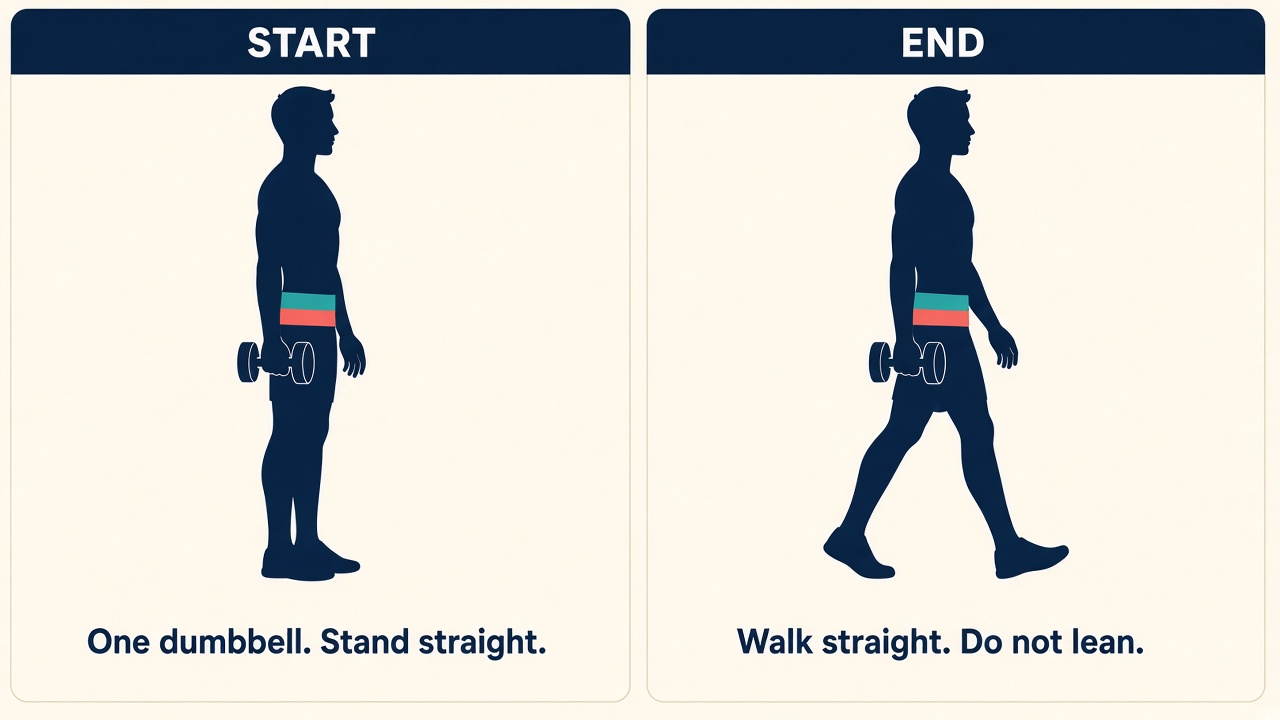
- One dumbbell. The other hand is empty.
- Walk 20 m without leaning away from the weight. Ribs stay stacked.
- Switch sides.
First session8 kg.
Add2 kg.
Back to session B
Side plank
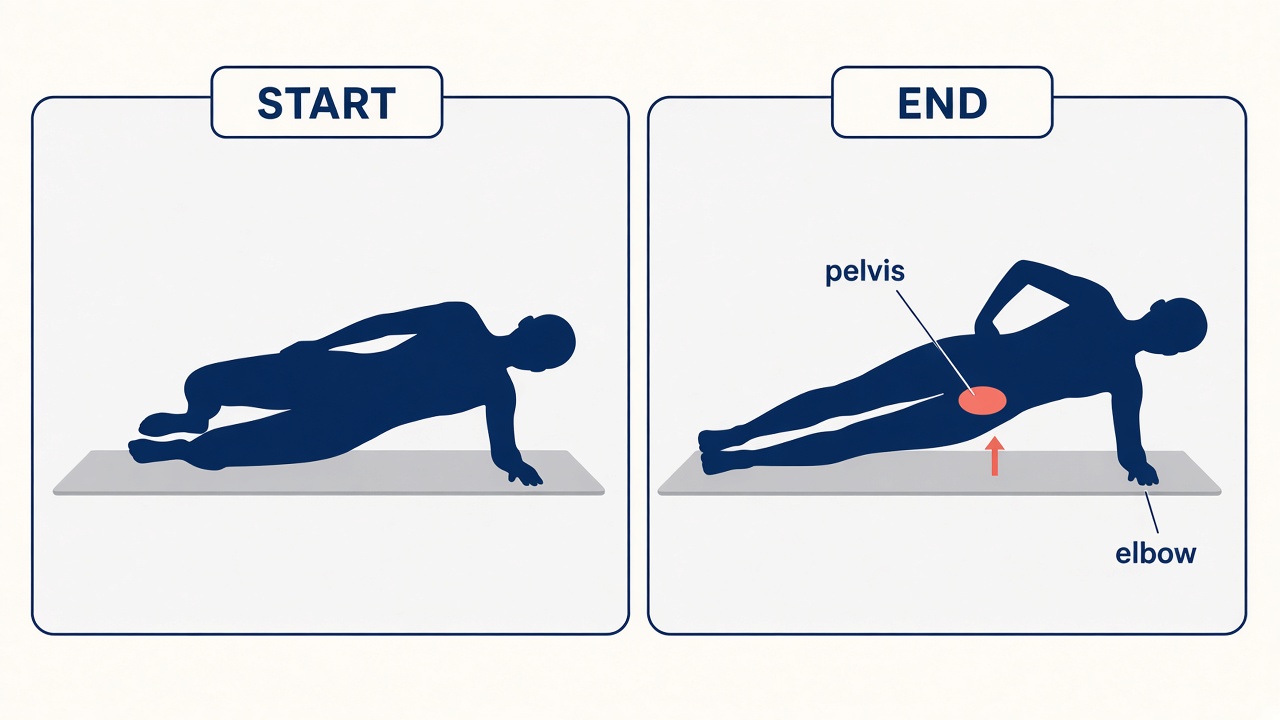
Only if the carry finishes early. Full cues are on the low-back page. Read it as a forearm support, not a front plank.
Dose20 seconds each side.
LoadBody weight. Do not add a weight here.
Back to session B
Hip hinge, no weight
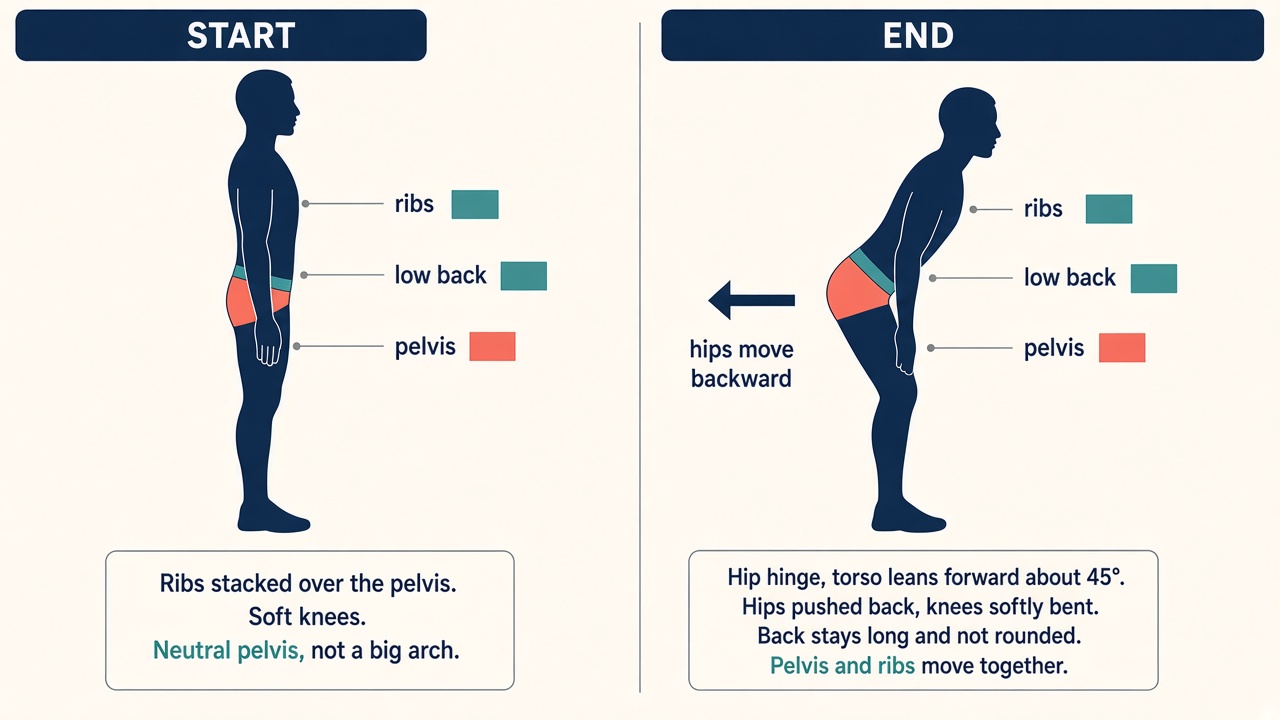
This is the warm-up hinge. The loaded version is the Romanian deadlift. Full cues are on the low-back page.
- Hands on the thighs. Soft knees.
- Slide the hands down as the hips go back. Ribs and pelvis move together.
- Stand tall. Six reps in the warm-up.
Back to the warm-up
Band pull-apart

Hands start in front of the chest, then pull wide until the band is tight. No band: 10 slow arm circles each way.
- Hands in front of the chest, a light band between them with a little slack.
- Pull the hands apart until the shoulder blades meet. Ribs stay down. Do not shrug.
- Return with control. 10 in the warm-up, or 12 paired with the press.
Back to the warm-up
Sources
Retrieved October 2026. Tiers: established means the finding is solid for the claim beside it. Indicated means useful and not settled. The phase split on this page is a practical adaptation, marked indicated above.
- Division Athletics. Programs. divisionathletics.sg/program. Gym’s own description, retrieved October 2026. Strength: 60 minutes, 14 weeks, hypertrophy then strength then performance. Conditioning: 45 minutes, in-season tests versus a 7-week off-season. Hybrid: strength, then skill, then a conditioning finisher. Established as what the gym says. Not proof that the split is optimal.
- Secret Life of Fatbacks. “5 more things I learnt about fitness after trying Division Athletics.” 15 March 2023. secretlifeoffatbacks.com. A visitor’s account of hypertrophy, strength, deload, and performance blocks. Indicated as a description of classes that year. The public program page does not name a deload.
- Spiering BA, Mujika I, Sharp MA, Foulis SA. Maintaining physical performance: the minimal dose of exercise needed to preserve endurance and strength over time. J Strength Cond Res. 2021;35(5):1449–1458. Narrative review. In younger adults, strength can be maintained for many weeks with one session a week if the load stays high. The authors say data are insufficient for athletes. Indicated for maintenance. Not a build plan.
- Rønnestad BR, Nymark BS, Raastad T. Effects of in-season strength maintenance training frequency in professional soccer players. J Strength Cond Res. 2011;25(10):2653–2660. One session a week for 12 weeks maintained squat strength and sprint performance. Every other week did not. Small sample of professional players. Indicated
- Cuthbert M, Haff GG, Arent SM, et al. Effects of variations in resistance training frequency on strength development in well-trained populations and implications for in-season athlete training: a systematic review and meta-analysis. Sports Med. 2021. doi:10.1007/s40279-021-01460-7. In well-trained people, over the lengths these studies ran, training more often did not clearly produce more strength. Indicated
- Huiberts RO, Wüst RCI, van der Zwaard S. Concurrent strength and endurance training: a systematic review and meta-analysis on the impact of sex and training status. Sports Med. 2024;54:485–503. doi:10.1007/s40279-023-01943-9. Small interference with lower-body strength gains in males. Not a reason to stop lifting. A reason to keep the hard run and the hard leg day apart. Established as a small effect in men.
- American College of Sports Medicine. Resistance training prescription for muscle function, hypertrophy, and physical performance in healthy adults. Position stand. Med Sci Sports Exerc. 2026. PMC12965823. At least two days a week for the main muscles. This hour is that strength work. The 15-minute mat page is the extra control work, not a second heavy plan.
- Bosquet L, Berryman N, Dupuy O, et al. Effect of training cessation on muscular performance: a meta-analysis. Scand J Med Sci Sports. 2013;23(3):e140–e149. doi:10.1111/sms.12047. Stopping lifting reduces strength, and longer breaks cost more. The difference becomes clearer after about 8 weeks for submaximal strength and about 16 weeks for a one-rep max. Established as a reason the April 2025 max is not a starting weight. The first-session kilos on this page are a practical guess for a 55 kg return, not a result from that paper.