Drills · desk, tennis, and long-distance running · 9 Oct 2026 · not a diagnosis
A quieter pelvis, stronger hips, and a low back that can last the day
You do not need to force your pelvis into a new shape. Build hip and trunk strength you can use while you sit, run, and play, and break up long sitting. That is the part with real support. Changing the tilt angle itself is a weak goal.
What the evidence actually says
Anterior pelvic tilt means the front of the pelvis sits lower than the back, so the low back arches more. It is common in people with no pain. A small average difference shows up in some back-pain studies. Trials that try to “correct” the angle are few and poor. Exercise helps many people with ongoing low-back pain. No one exercise style has won.
Claim
What was found
How sure
People with back pain have more pelvic tilt
A 2014 review found no clear difference in standing tilt.1 A 2024 review of 23 comparisons found a small difference (SMD 0.23) with a lot of disagreement between studies (I² = 72%). The authors would not draw a firm conclusion.2
Indicated small link, not a cause
Fixing the tilt removes pain
A 2020 review found four weak studies. One trial in men without pain changed tilt by less than 2°. There was no overall evidence that non-surgical treatment reduces tilt or the symptoms blamed on it.3
Established as a gap: do not chase degrees
Exercise helps ongoing low-back pain
Cochrane, 249 trials: exercise is probably better than no treatment for pain (about 15 points on a 0–100 scale). Gains in daily function were smaller. No single exercise type stood out.4 NICE says stay active and pick exercise you can keep doing.5
Established
Hip and trunk work helps runners more than stretching alone
In novice runners, a physio-guided hip-and-core programme cut lower-limb injury versus static stretching (HR 0.66) over 24 weeks.6 A 2025 review: hip-strength training makes the hips stronger, but that does not reliably change running form.7
Indicated for novices; form change is weak
Hip-flexor stretches with a pelvic tuck
One session in healthy adults: a half-kneeling stretch with a posterior tuck reduced hip-flexor tension more than a plain lunge stretch.8 An 8-week stretch trial in women with back pain and limited hip extension improved motion and pain inside that group, but the group-by-time test was not significant.9 In older adults, 10 weeks of hip-flexor stretching helped stride only in those who already lacked hip extension when walking.10
Indicated for motion; pain effect is weak
A short break every 30–45 minutes of sitting
Young adults with back pain who took a short active break at least every 30 minutes for 12 weeks improved pain and disability versus self-care advice. They were students, not office workers.11
Indicated
Bird dog and side plank as a special cure
A 34-person trial: McGill-style exercises (curl-up, side bridge, bird dog) and ordinary physio exercises both helped. The groups were not clearly different.12
Indicated they are reasonable, not magic
What “better” means here. You can sit for 45 minutes and reset without a spike. Next-morning hip and back soreness stays mild. A hinge and a lunge feel steady with the ribs down. Tennis and runs do not have to start from a stiff, arched low back. A change of a few degrees on a photo is not the target.3
Two sources disagree on the tilt–pain link. The older pooled studies found no standing difference.1 The newer, larger review found a small one and still refused a firm conclusion because the studies do not measure tilt the same way.2 Use the newer review for “there may be a small difference.” Use the treatment review for “shrinking that difference is not a proven fix.”3
A 2024 review linked back pain more clearly with a foot that rolls in, and with the hip turning inward, than with a simple tilt story. The studies were mixed, so this is not a diagnosis.13 It is why the plan includes side steps and single-leg work. NICE says not to buy foot orthotics or a back brace for ordinary low-back pain.5
Hamstring stretching is not the priority. The hamstrings attach to the sit bones and can tug the pelvis back. If the pelvis already tips forward, those muscles are often already on stretch. That “already long” idea is anatomy plus clinic habit, not a settled trial (Speculative as a rule for everyone). Stretch hamstrings only if they stop you hinging with a long spine, and stop at a mild pull.
Safety before you start
This is general information for an adult who wants to train at home. It is not a personal assessment. Sharp pain, pain that spreads, or a joint that pinches means stop that exercise. Muscle work can feel like 3 out of 10 and should be back to baseline by the next morning. Stretches stay at 5–6 out of 10: tight, you can still breathe, you are not wincing.
Breathe out on the effort. Do not hold your breath.
Skip a strength day if you are ill, or if yesterday’s session left you worse this morning.
Do the heavier hinge and lunge on days that are not your long run. Easy control work can sit beside tennis.
See a physio if pain still limits sitting, running, or tennis after 2–3 weeks of easier loads plus this plan, or if you cannot tell whether your low back is staying quiet. A side-on phone video is enough to check.
Ask a clinician first if you are pregnant, have had recent surgery, have osteoporosis, or have a known spine, hip, or nerve condition.
Strength dose follows the American College of Sports Medicine: train the main muscles at least twice a week. Bodyweight and bands count. Two or more sets are enough to adapt.14 Three or four short sessions fit a week that already has running and tennis. Stretch most days if you sit a lot. Hold a static stretch 10–30 seconds, at tightness or slight discomfort, not pain. The flexibility numbers come from the 2011 ACSM stand.15
1. Strength and control
About 15 minutes, 3 days a week. A fourth day only if your legs feel fresh and it is not the morning of a long run. Session A is control. Session B is the hinge, the hip lift, and single-leg work. Do the breathing drill at the start of both.
The default kit is a mat, plus a light band for the side step. The hip thrust and the Romanian deadlift each have a mat alternative in the next card. Use those. Heavier lifting already has a home in the gym hour: a squat or split squat, a press or row, a loaded hinge, and a carry. Leave the dumbbells there.
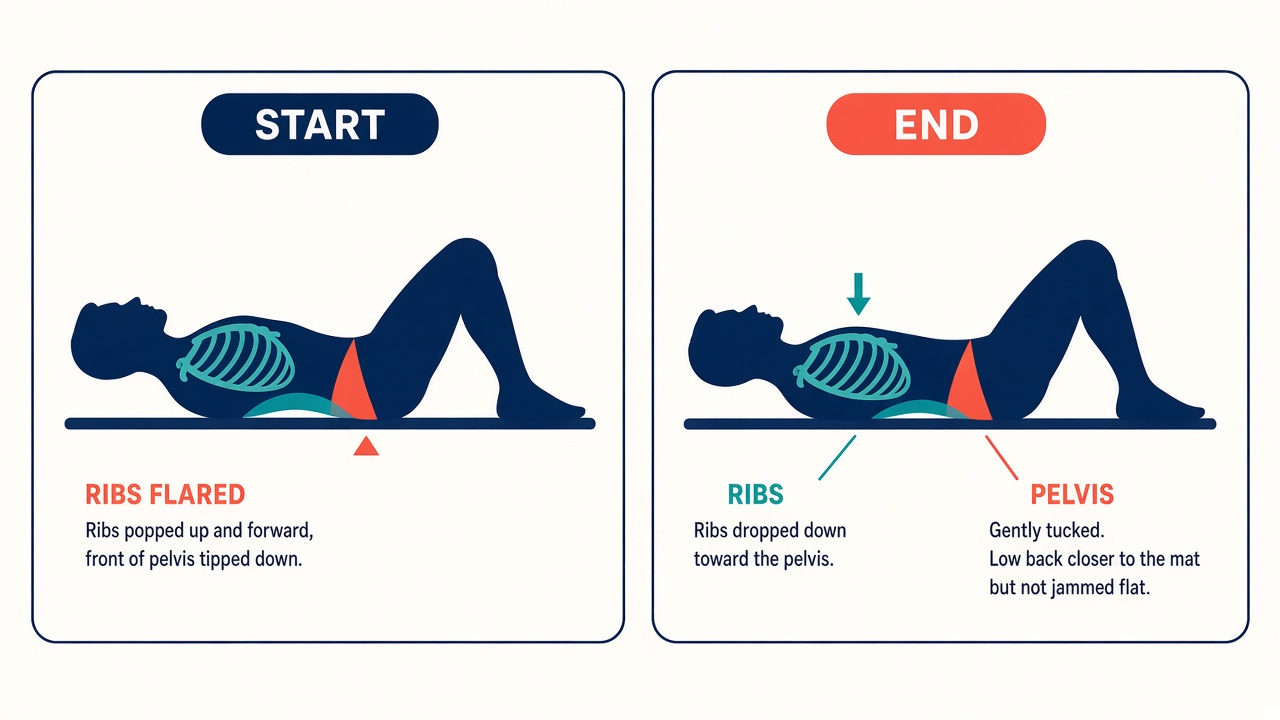
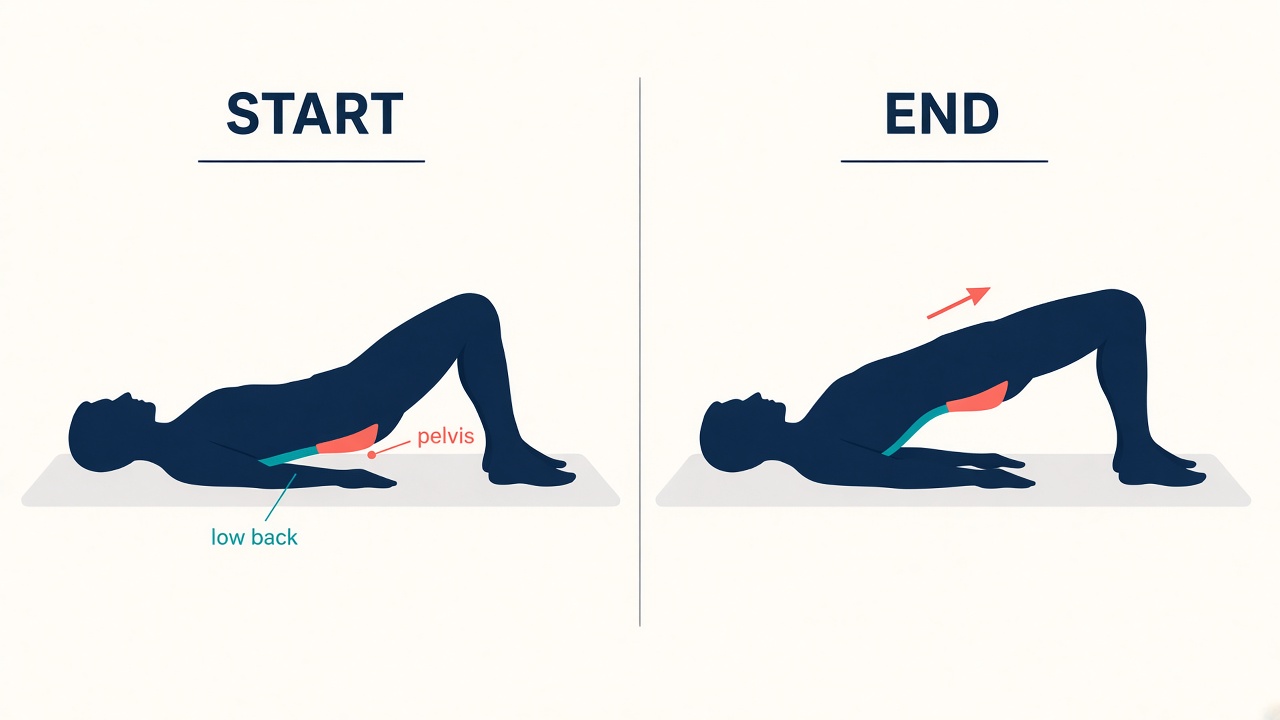
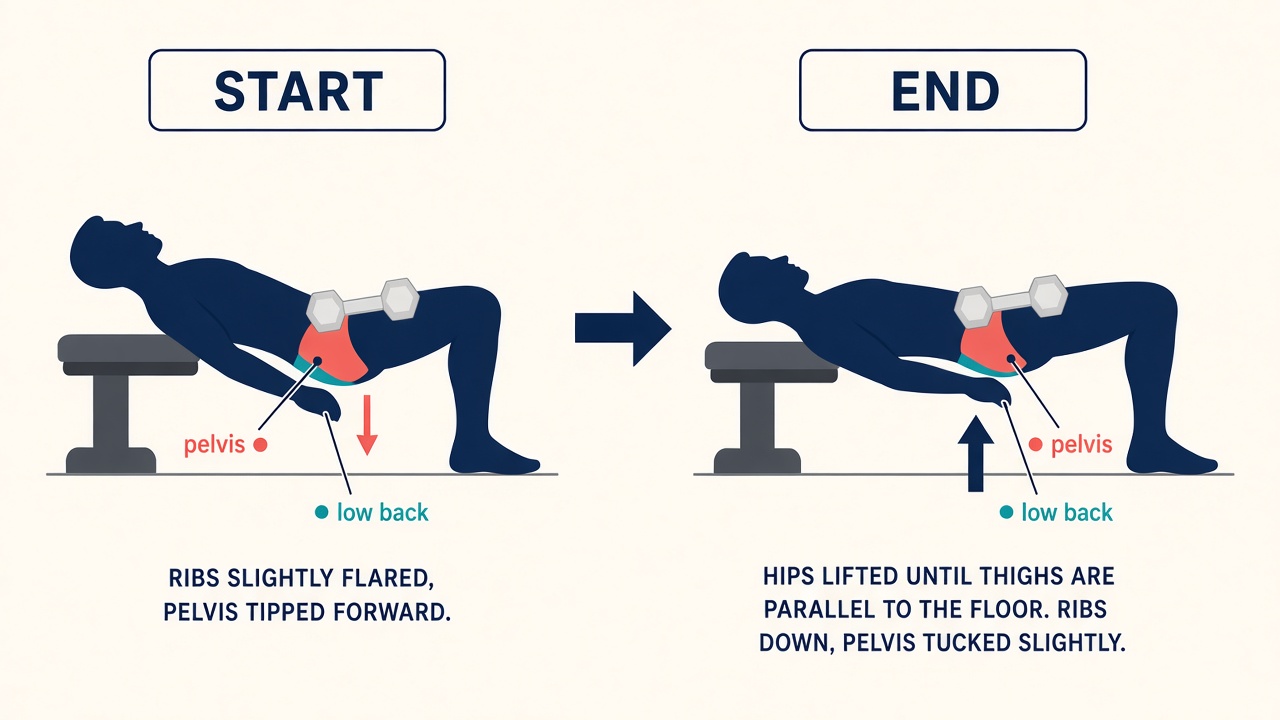
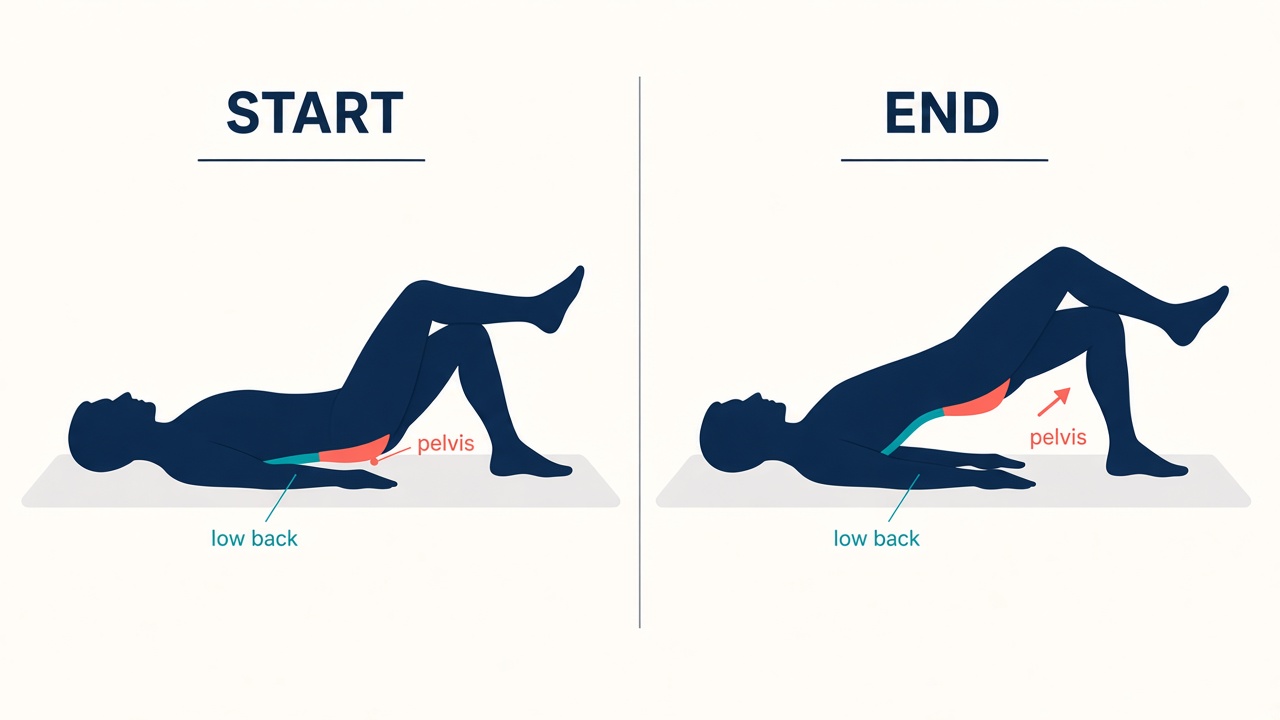
Coral marks the pelvis. Teal marks the low back. Pictures are original teaching drawings, not photos. Where a drawing is slightly off, the written cue wins. Film yourself from the side once.
Do this first · every session and at the desk
Rib-down breathing
Teaches the ribs to sit down on the pelvis so the low back does not have to arch to “stand tall.”
Side view, lying down. The same breath works in a chair. You are changing the ribs, not sucking the belly in hard.
Lie on your back, knees bent, feet flat. One hand on the low ribs, one on the belly.
Inhale through the nose into the sides and back of the ribs.
Exhale slowly and let the ribs drop toward the belt. The low back gets closer to the mat. Do not jam it flat or tuck so hard the glutes cramp.
Keep that quieter rib position as you breathe in again.
Repeat 5 breaths before the other exercises.
Dose5 slow breaths. About 1 minute.
Key cueSoft exhale, ribs heavy, belt gentle toward the ribs.
Common mistakeSucking the belly in and holding the breath, or flattening the back by force.
Easier / harderEasier: knees higher, feet on a chair. Harder: keep the same ribs while you bridge or hinge.
Image spec and regeneration prompt
Side view, start and end. Start shows flared ribs and a tipped pelvis. End shows ribs down, a small downward arrow, pelvis gently tucked, low back nearer the mat but not crushed. Neutral background, coral pelvis, teal ribs.
Glute bridge
Wakes the glutes and lets you practise a hip lift without arching the low back.
Side view. Lift the hips. The ribs stay down.
Lie on your back, knees bent, feet flat, hip-width. Arms by your sides.
Exhale, drop the ribs, gently brace.
Push through the heels and lift the hips until shoulders, hips, and knees line up.
Pause 2 seconds. Glutes do the work. Front of the hips stays quiet.
Lower slowly. Do not rest into a big arch between reps.
Dose3 × 8–12. Session A.
Key cueKnees forward, ribs down, squeeze the glutes at the top.
Common mistakePushing the ribs up and arching the low back to get higher.
Easier / harderEasier: smaller lift. Harder: 3-second lower. The single-leg version is the Session B mat alternative below.
Bench version · mat alternative is the next card
Hip thrust
Same hip-extension job as the bridge, through a larger range, so the glutes work harder. Skip it when you only have a mat.
Side view. Shoulders stay on the bench or sofa. If the drawing puts the weight on the belly, slide it down onto the hip bones.
Sit with shoulder blades on a bench or sofa edge. Feet flat, knees bent about 90°.
Optional: a light dumbbell across the hips, padded with a towel.
Exhale, ribs down, then drive the hips up until the torso and thighs line up.
Pause 1–2 seconds. Chin stays tucked. Look forward, not at the ceiling.
Lower with control until the hips are just off the floor. Repeat.
Dose3 × 8. Session B.
Key cueHips to the ceiling, ribs to the pelvis.
Common mistakeOver-arching at the top, or the knees caving in.
Easier / harderMat alternative: single-leg glute bridge, next card. Harder, only in the gym hour: a light dumbbell on the hips.
Mat only · use this instead of the hip thrust
Single-leg glute bridge
The hip thrust’s job, on the floor. One leg makes it harder than the two-leg bridge you do on Session A.
Side view, on the mat. One foot stays down. The free leg stays up. Both hips stay level.
Lie on your back, knees bent, feet flat. Ribs down.
Lift one foot. Keep that thigh roughly in line with the other thigh.
Push through the down heel and lift the hips until the shoulders, hips, and standing knee line up.
Pause 2 seconds. The free hip does not drop. Lower slowly.
Finish the reps on one side, then switch.
Dose3 × 6–8 each leg. Session B.
Key cueLevel hips, ribs down, squeeze the glute of the foot on the floor.
Common mistakeThe free hip drops, or the low back arches to get higher.
Easier / harderEasier: the free toes tap the floor. Harder: hold the top for 2 seconds, then take 3 seconds to lower.
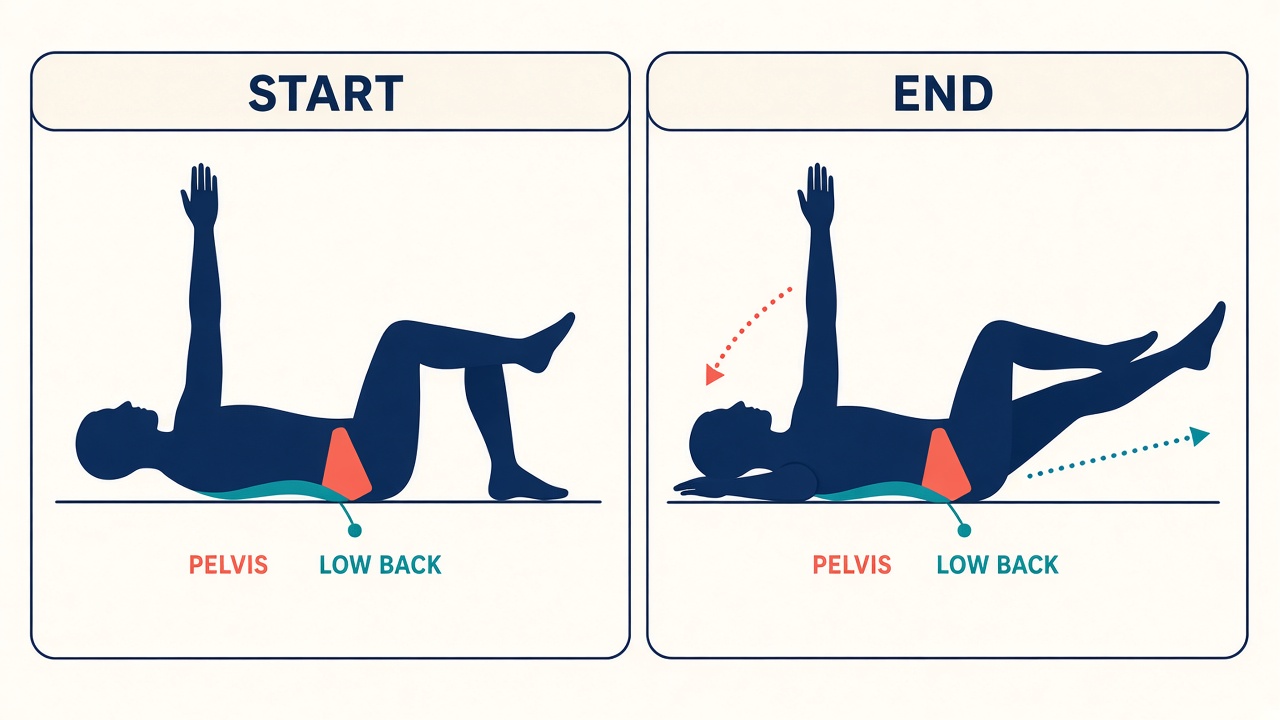
Dead bug
Trains the trunk to stay steady while the arms and legs move, which is what sitting, serving, and running ask of you.
Side view hides the far arm. Both arms start toward the ceiling. Move the opposite arm and leg. Keep the low back near the mat.
Lie on your back. Hips and knees at 90°. Arms point at the ceiling. Ribs down.
Exhale and reach one arm overhead and the opposite leg away, both hovering.
Only go as far as the low back stays quiet. A small arch that grows is too far.
Return. Switch sides. Move slowly.
If the back peels off the mat, shorten the reach.
Dose2–3 × 6 each side. Session A.
Key cueExhale as the limbs leave. Low back stays heavy.
Common mistakeLetting the ribs pop up as the leg straightens.
Easier / harderEasier: slide one heel along the floor, arms stay up. Harder: longer reach, 2-second hold, then a light band around the feet.
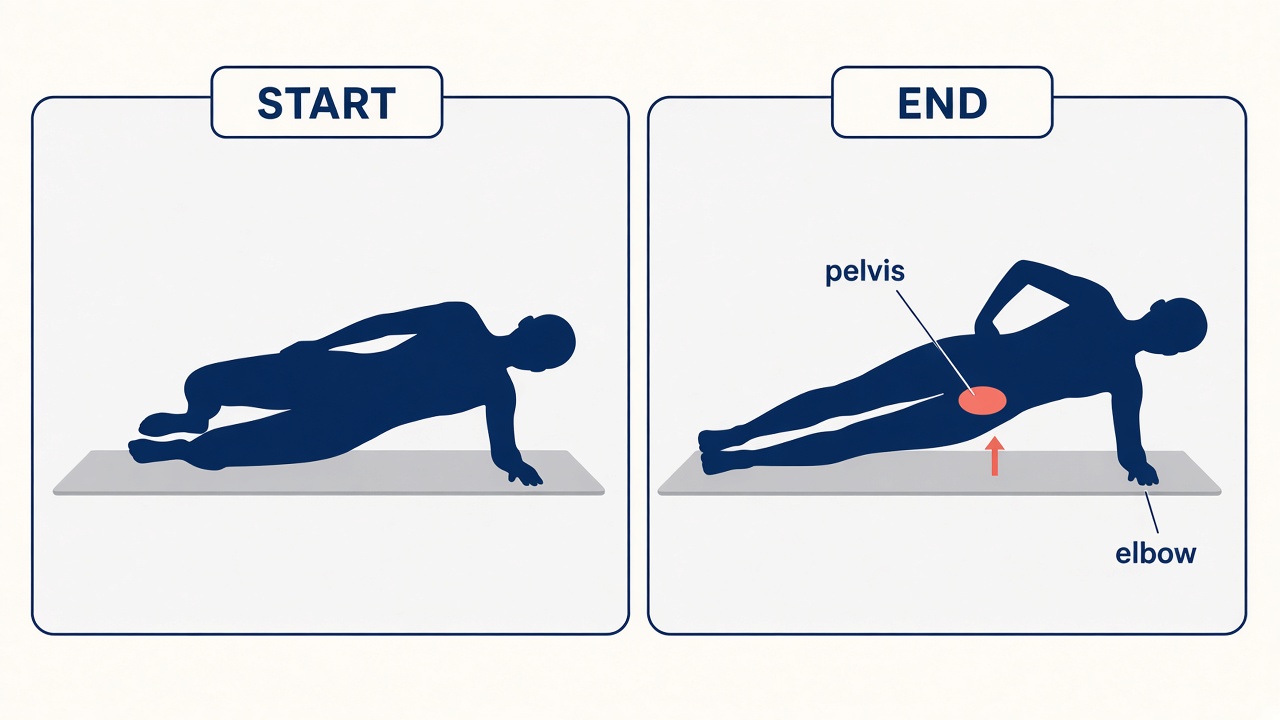
Side plank
Builds the side of the trunk and the side of the hip so the pelvis does not drop when you run or change direction.
Viewed from the front while you are on your side. Rest on the forearm, elbow under the shoulder. If the end drawing looks like a straight arm, bend the elbow.
Lie on your side. Elbow under the shoulder. Knees bent and stacked.
Exhale, lift the hips so the body is a straight line from ear to knees.
Top hand on the hip. Do not let the hips sag or twist forward.
Breathe. Hold. Lower with control.
Switch sides. Match the weaker side. Do not chase the stronger one.
Dose2–3 × 20–40 seconds each side. Session A.
Key cueElbow under shoulder, hips forward, long line.
Common mistakeHips dropped, or rolled so the belly faces the floor.
Easier / harderEasier: knees bent, shorter hold. Harder: legs straight, then top leg lifted a few centimetres.
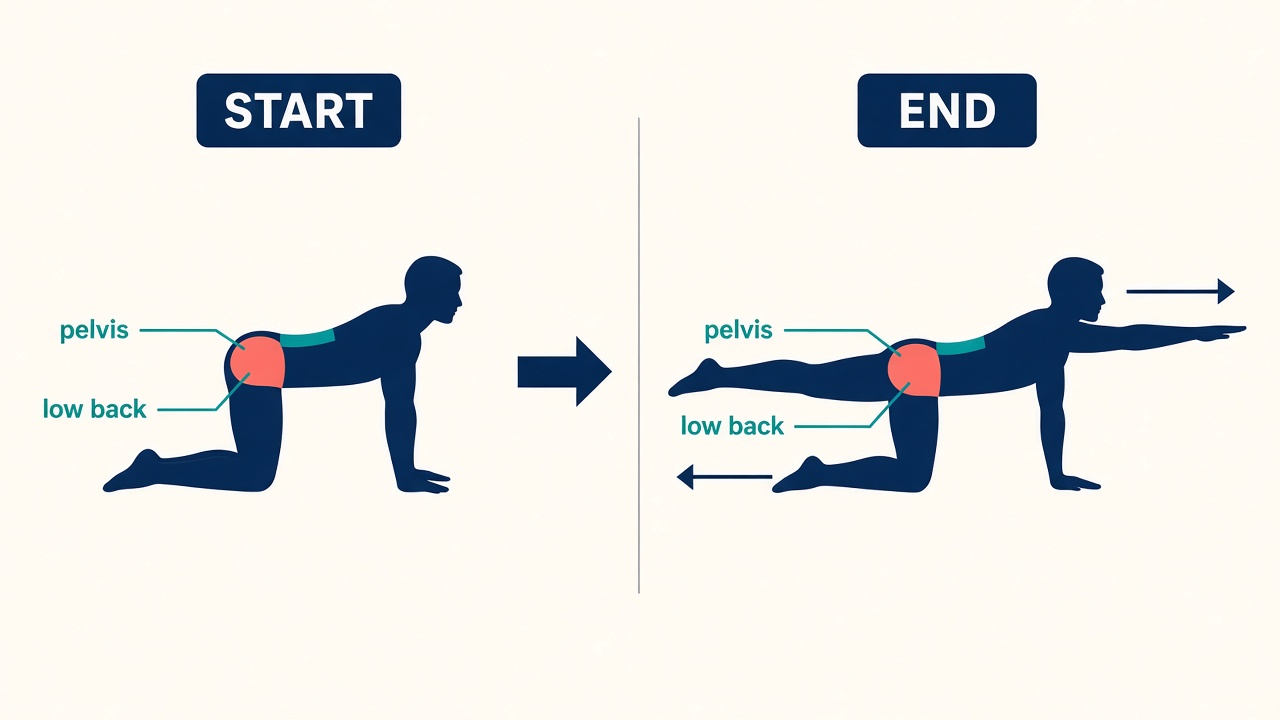
Bird dog
Teaches a still pelvis while one arm and the opposite leg reach, which is closer to walking and a tennis swing than a sit-up is.
Side view. Trust the pose if a label looks swapped: the coral patch is the pelvis. Keep it still. Reach opposite arm and leg.
Hands under shoulders, knees under hips. Spine long. Eyes to the floor.
Exhale and slide one leg back and the opposite arm forward.
Stop when both are about parallel to the floor. Hips and shoulders stay square.
Hold 3 seconds. Do not twist or sag. Return knee then hand.
Switch sides.
Dose2–3 × 6 each side. Session A.
Key cueReach long, pelvis quiet, no extra arch.
Common mistakeLifting the leg so high the low back sags, or hiking one hip.
Easier / harderEasier: arm only, then leg only. Harder: hold 5 seconds, or draw small slow circles with the reaching hand.
Weight version · mat alternative is the next card
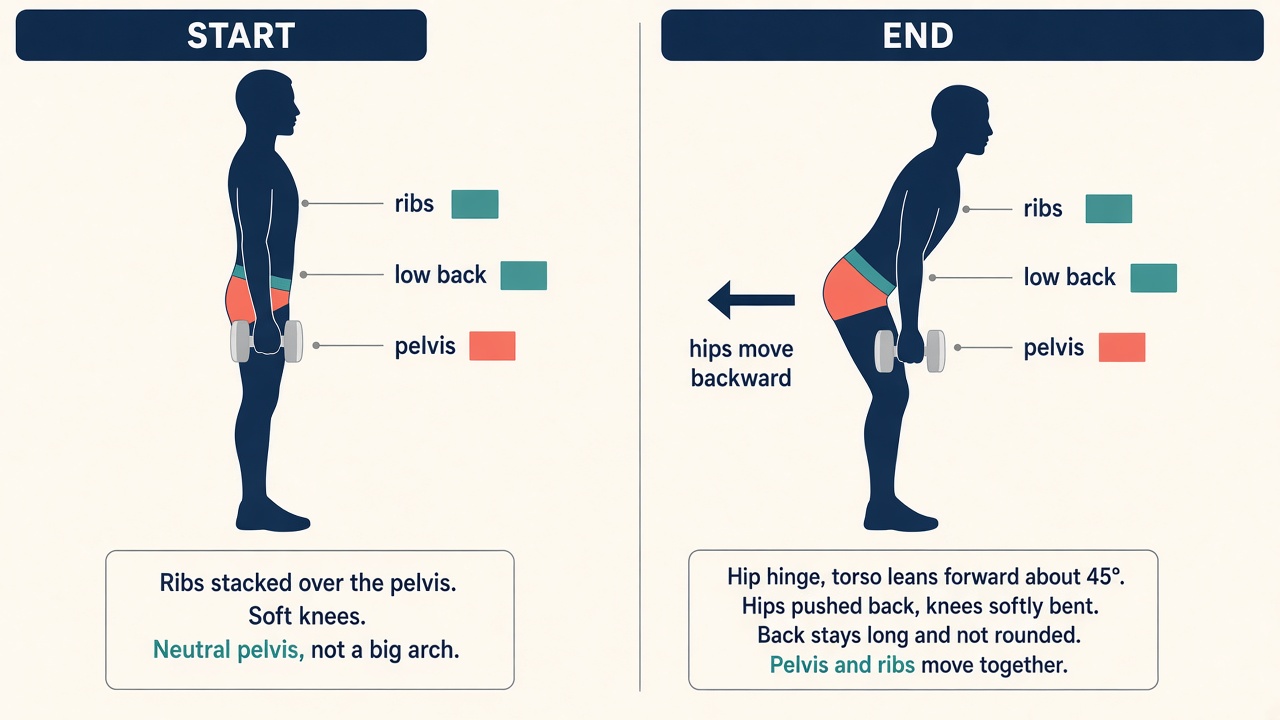
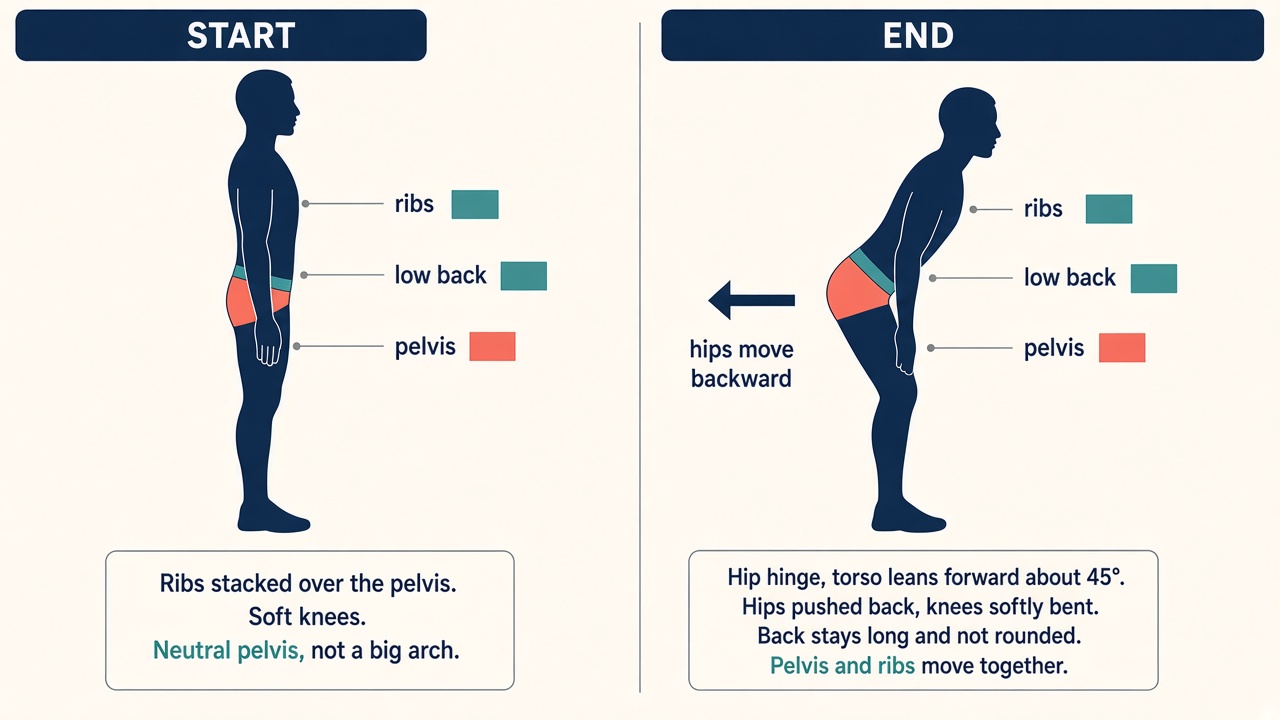
Romanian deadlift
Loads the glutes and hamstrings in a hinge, so the low back is not the thing that bends. This is the gym-hour version. On a mat, use the bodyweight hinge below.
Side view is the one that matters. Hips go back. Ribs and pelvis move together. The back stays long.
Stand tall, soft knees, ribs stacked over the pelvis. Weights in front of the thighs, or hands empty.
Exhale. Send the hips back as the chest tips forward. Shins stay nearly vertical.
Stop when the hamstrings tighten or the back wants to round. Often around mid-shin to the knees.
Keep the weights close. Drive the hips forward to stand. Glutes finish the stand.
Do not bounce at the bottom.
Dose3 × 8, in the gym hour. Not the morning of a long run.
Key cueHips back, chest proud, ribs and belt stay stacked.
Common mistakeSquatting down, or rounding the low back to reach lower.
Easier / harderMat alternative: bodyweight hinge, next card. Harder: this lift, with the load you already use in the gym.
Mat only · use this instead of the Romanian deadlift
Bodyweight hinge
The same hip-back pattern as the Romanian deadlift, with empty hands, so the low back stays long while the hips do the bending.
Side view. No weights. Hips go back. Hands slide down the thighs. Ribs and pelvis move together.
Stand tall, soft knees, ribs stacked over the pelvis. Hands on the front of the thighs.
Exhale. Send the hips back as the chest tips forward. Shins stay nearly vertical.
Slide the hands toward the knees. Stop when the hamstrings tighten or the back wants to round.
Drive the hips forward to stand. Glutes finish the stand.
Do not bounce at the bottom.
Dose3 × 8. Session B. Not the morning of a long run.
Key cueHips back, hands on the thighs, ribs and belt stay stacked.
Common mistakeSquatting down, or rounding the low back to reach the floor.
Easier / harderEasier: a smaller tip, hands higher on the thighs. Harder: 3 seconds down, pause 1 second. Add a dumbbell only in the gym hour.
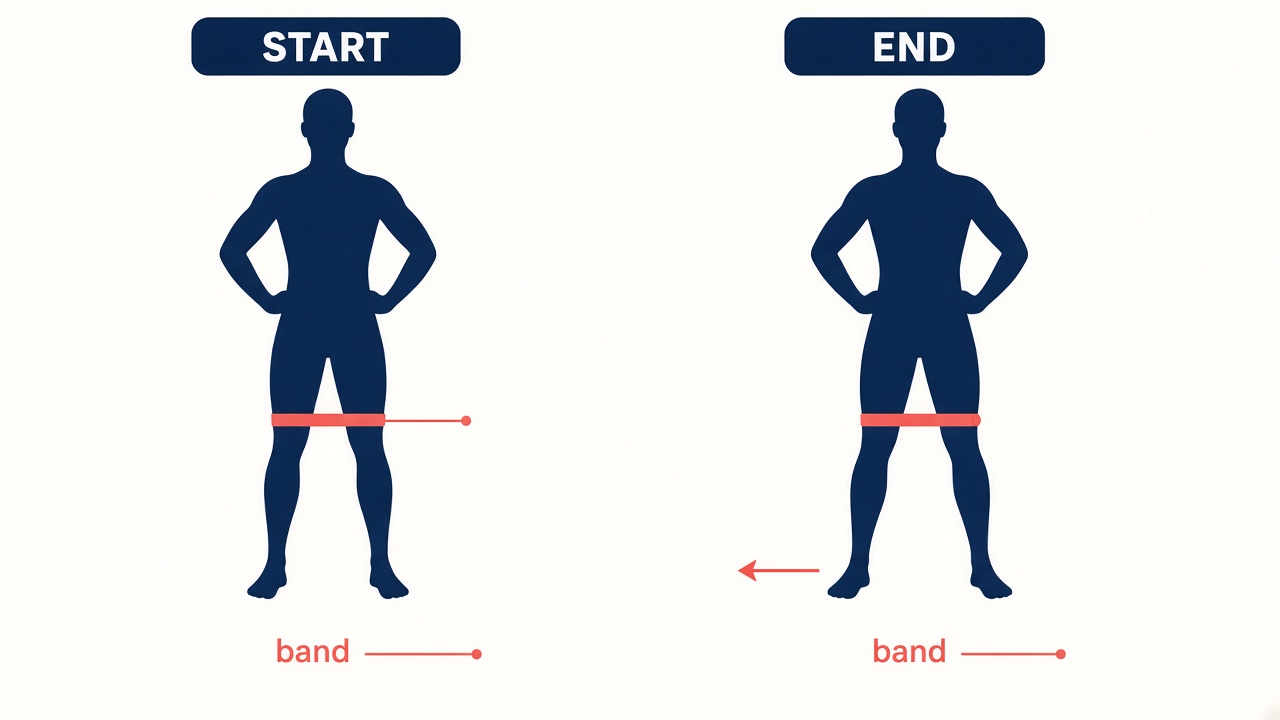
Banded side step
Works the side glutes that keep the pelvis level when you land on one leg or push off for a wide ball.
Front view. One band, just above the knees. Pelvis faces forward and stays level.
Band around the thighs, just above the knees. Soft knees, ribs down, hands on hips.
Step sideways a short distance. Both knees stay pushed gently out into the band.
The trailing foot follows, but do not click the feet together.
Keep the shoulders quiet. Do not lean.
8 steps one way, then the other way.
Dose2 × 8 steps each way. Session B.
Key cueKnees out, trunk tall, small steps.
Common mistakeFeet turned out and a waddle, or the knees collapsing in.
Easier / harderEasier: no band, or a lighter band. Harder: band at the ankles, or a 2-second pause on the stepping leg.
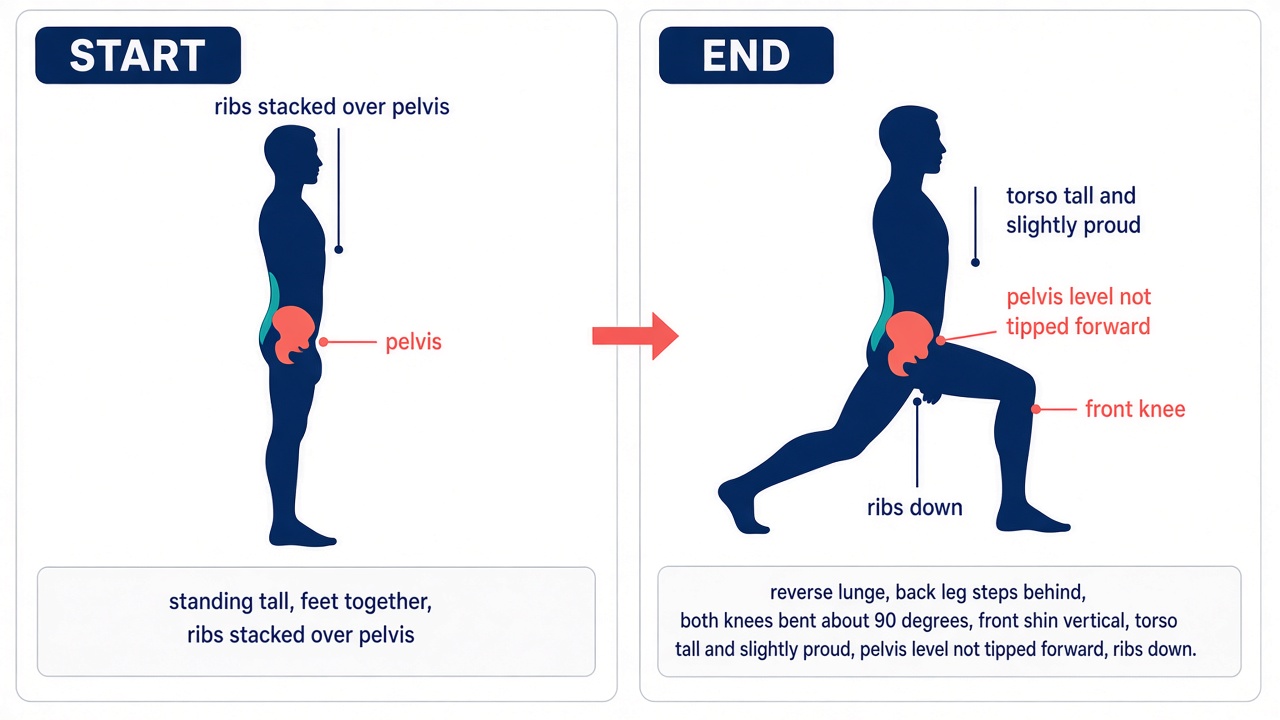
Reverse lunge
Single-leg strength for running and court movement, with the pelvis level instead of dumped forward.
Side view. Front shin stays close to vertical. Ribs stay down. The back heel can lift.
Stand tall, feet hip-width, ribs over the pelvis.
Step one foot back and lower until both knees are softly bent.
Front knee tracks over the middle of the foot. It does not dive inward.
Push through the front foot to stand. Do not shove the hips into a big arch.
Finish the reps on one leg, then switch.
Dose2–3 × 6 each leg. Session B.
Key cueTall torso, front knee quiet, stand through the glute.
Common mistakeFront knee past the toes with the heel lifting, or the low back arching as you stand.
Easier / harderEasier: a small split stance and a shallow bend, hand on a wall. Harder: 3 seconds down. A dumbbell lunge belongs in the gym hour.
Weekly schedule
Three strength days is the plan. The fourth is optional. Long-run morning stays free of Session B. Desk resets happen every workday, including strength days.
Day
Strength, about 15 min
Mobility
Sport
Mon
A: breath, dead bug, bridge, bird dog, side plank
Desk resets
Tennis or rest
Tue
Off
Desk resets + evening 8 min
Easy run, with the warm-up and cool-down
Wed
B on a mat: breath, single-leg bridge, bodyweight hinge, lunge, band walk
Desk resets
Tennis or rest
Thu
Off
Desk resets + evening 8 min
Easy or rest
Fri
A again
Desk resets
Optional hit
Sat
Off. Optional B only if legs are fresh and this is not the long run
Morning or post-run mobility
Long run
Sun
Off
8 quiet minutes, or a walk
Rest
Six to eight weeks
Weeks
What to change
Stop and stay here if
1–2
Easier versions. 2 sets. Learn the rib-down breath. Leave 2 reps in reserve.
Next-morning pain is above 3/10 or you change your stride or serve to cope.
3–4
Use the full doses on the cards. Film one side view of the hinge and the bridge.
The low back arches as soon as you add a rep. Shorten the range instead.
5–6
Lower for 3 seconds on the single-leg bridge and the bodyweight hinge. Keep the dumbbells in the gym hour.
Tennis or the easy run feels worse, not just worked. Drop the load, keep the practice.
7–8
Harder mat versions: a 2-second pause on the single-leg bridge, a longer side plank, the band at the ankles, a slower hinge.
You are in a race block or a heavy tennis week. Hold weeks 5–6 until the calendar eases.
After week 8, keep two or three sessions a week. Strength fades if it disappears. You do not need a new programme. Slow the lower, or use the harder mat version, when the current one feels easy and the next morning is fine. Extra weight stays in the gym hour.14
2. Daily stretches and desk resets
Holds are 20–30 seconds unless noted. Intensity is 5–6 out of 10. You should be able to talk. Pain in the front of the hip joint, the groin, or down the leg means ease off or skip that stretch. A stretch is a helper. In novice runners, hip-and-core strength beat a stretching-only plan for injury.6 Do not swap Section 1 for a longer stretch routine.
A. Desk-friendly
One or two of these each break. The full set is about 5 minutes if you do it once in the afternoon.
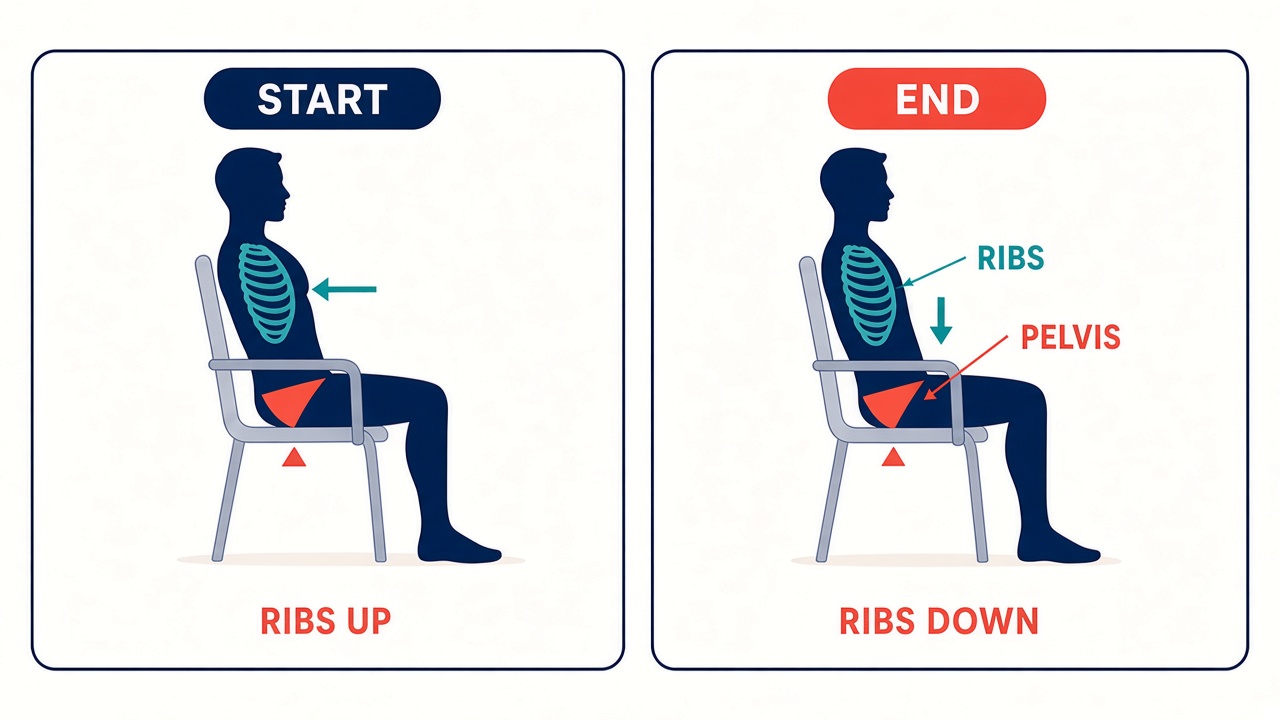
Seated rib reset
Target: ribs and low back. Same breath as the floor drill, in the chair.
Side view, in the chair. Feet stay flat. The change is small: ribs drop, the low back gets quieter. Do not slump.
Sit with feet flat. Scoot back so the pelvis is supported, or sit on the front of the chair if the backrest pushes you into a slump.
Grow tall, then exhale and drop the ribs. Do not puff the chest.
5 breaths, about 1 minute.
Hold5 breaths.
IntensityAlmost none. This is position, not a stretch.
Common mistakeLifting the chest and arching to look “upright.”
Standing hip-flexor shift
Target: front of the hip on the back leg. A desk-height version of the half-kneeling stretch.
The drawing is the floor version in part B. At the desk, use a split stance: back heel down, back knee soft, same tuck. Hold a chair if you wobble.
Split stance. Back heel stays down. Both feet point forward.
Exhale, tuck the pelvis slightly (belt toward ribs), then shift the hips a little forward.
You should feel the front of the back-leg hip, not a pinch in the groin and not a big arch in the low back.
Hold 30 seconds. Switch sides.
Hold30 seconds each side. 5–6/10.
Common mistakeLeaning the torso back and arching the low back to “feel more.”
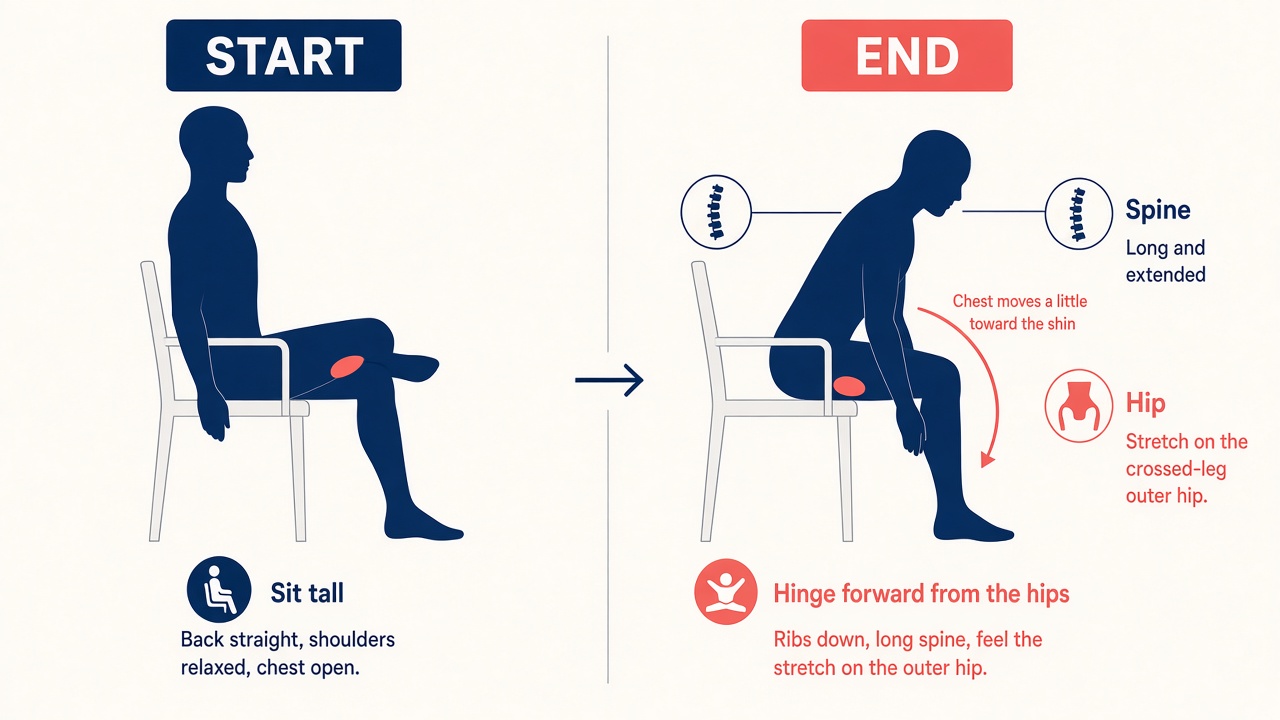
Seated figure-4
Target: outer hip and buttock of the crossed leg.
Side view. Hinge from the hips. The spine stays long.
Ankle on the opposite knee. Flex the crossed foot a little.
Sit tall, ribs down.
Tip the chest toward the shin a short way. Stop at 5–6/10 on the outer hip.
Hold 30 seconds. Switch.
Hold30 seconds each side.
Common mistakeRounding the low back, or pushing through a pinch at the front of the hip.
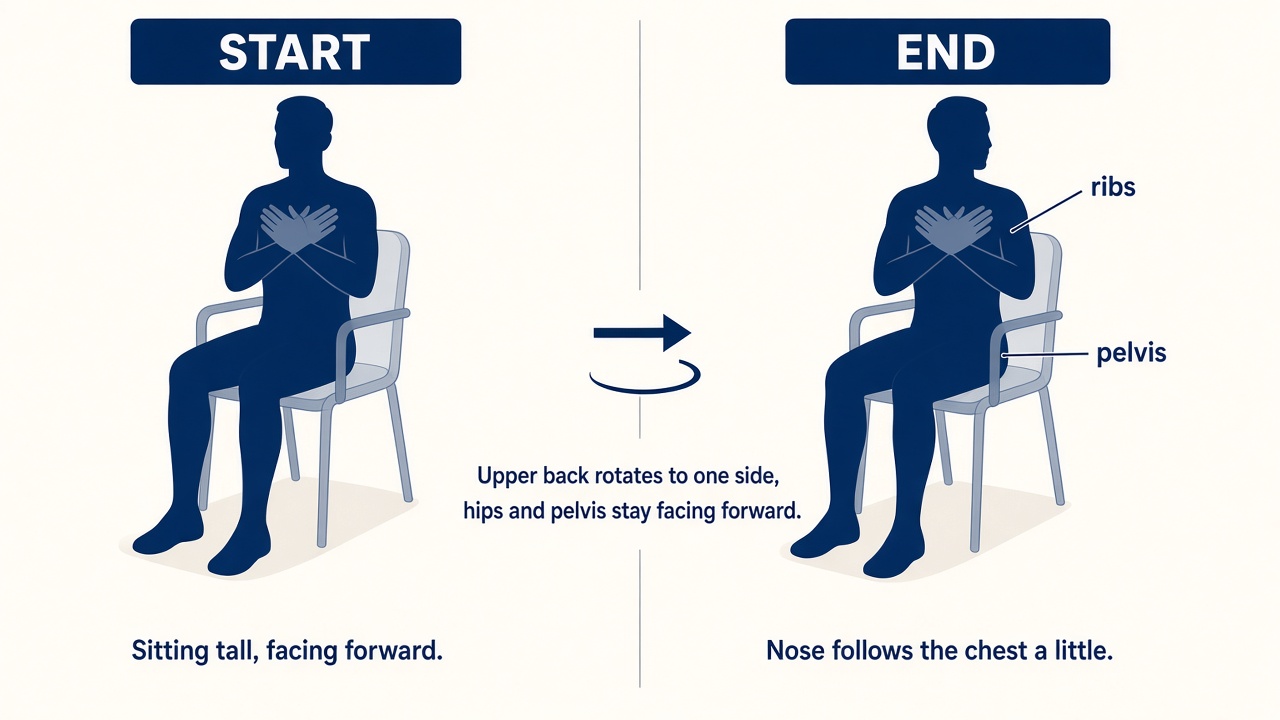
Seated upper-back rotation
Target: mid back. Useful before tennis, when the low back has been doing the turning.
Hips and pelvis stay facing the desk. The chest turns. If the drawing looks almost front-on, turn a little more, but keep the pelvis still.
Sit tall, feet flat, arms crossed on the chest.
Turn the chest to one side. Nose follows a little. Pelvis does not.
5 slow turns each side. Do not hold a hard end range.
Dose5 each side. Easy, not 5–6/10.
Common mistakeTurning by twisting the low back and the pelvis with it.
Stand and squeeze
Target: glutes and upright posture, in 20 seconds, with no floor.
Stand, feet hip-width, ribs down.
Gently squeeze both glutes. The pelvis tucks a little. Knees stay soft, not locked.
Hold 5 seconds, relax, repeat 4 times.
Dose4 × 5 seconds.
Common mistakeSqueezing so hard you tuck under and round the whole back.
No separate drawing. Side view should look like the start of the Romanian deadlift: ribs stacked, not a big arch.
B. Morning or evening mobility
5–10 minutes. On training days, do it away from the long run, or after the cool-down. Order below is the full set. If you only have 5 minutes, do the hip flexor, the figure-4, and cat-camel.
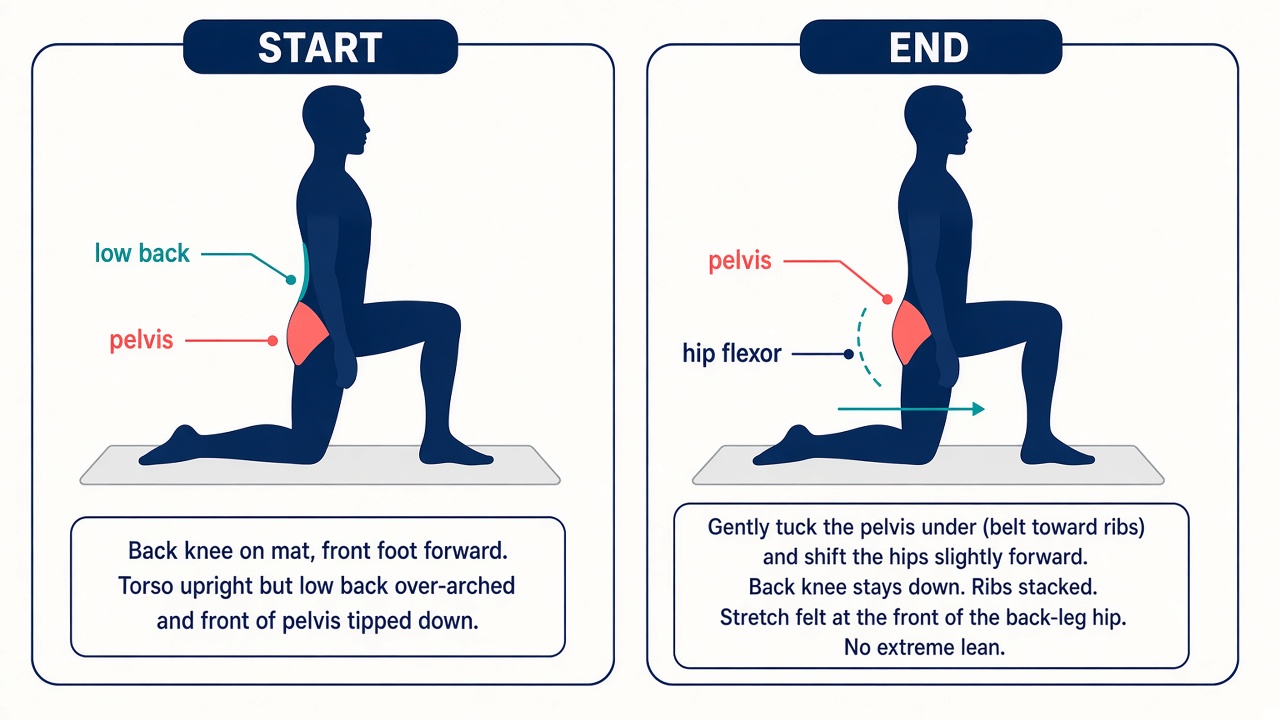
Half-kneeling hip flexor, with a tuck
Target: front of the hip. The tuck is the part that beat a plain forward lunge in a small study of healthy adults.8
Side view. Back knee on a pad. The change from start to end is a small tuck and a small shift, not a deep lunge.
Back knee on a mat, front foot forward, torso tall.
Gently tuck the pelvis (belt toward ribs) so the low back quietens.
Shift the hips forward a little until you feel the front of the back-leg hip at 5–6/10.
Hold 30 seconds. Breathe. Switch. Optional second round.
Hold2 × 30 seconds each side if it feels useful. Otherwise once.
Common mistakeArching the low back, or pushing into a groin pinch.
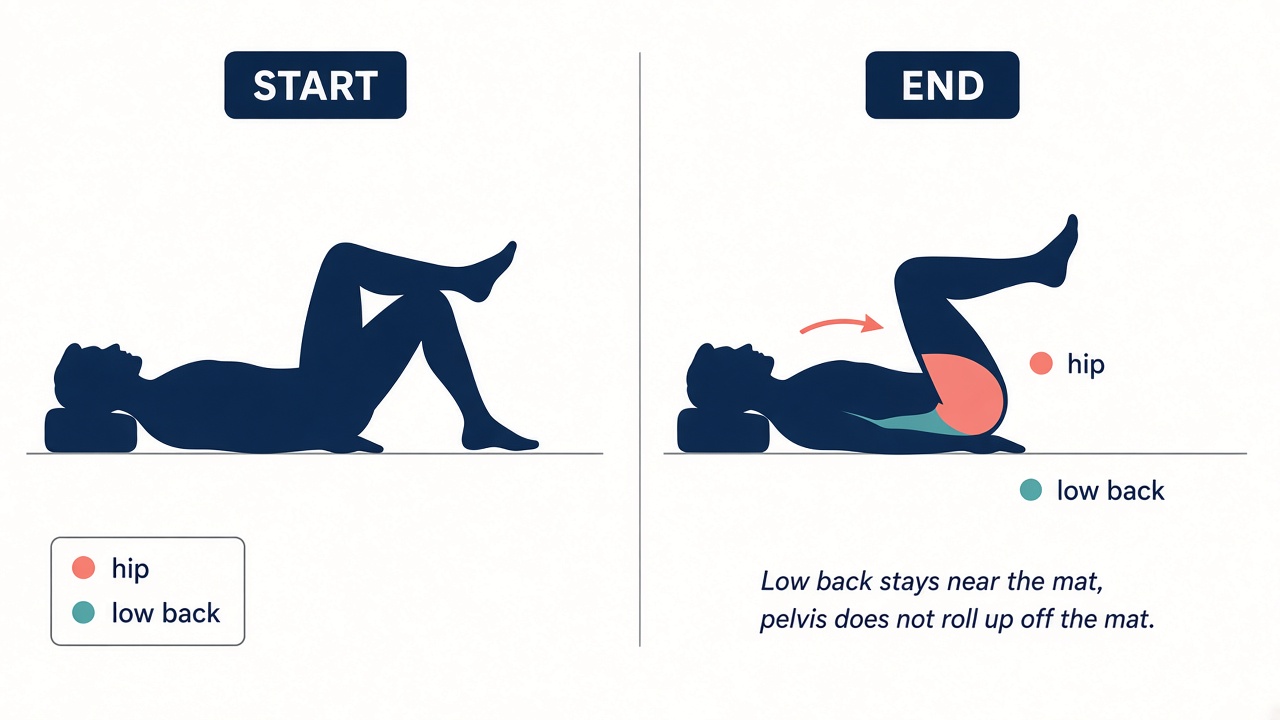
Supine figure-4
Target: outer hip, without standing on a tired leg after a run.
Side view. Low back stays near the mat. Do not roll the pelvis up to pull harder.
On your back. Ankle across the opposite knee.
Draw the uncrossed thigh toward you until the outer hip feels 5–6/10.
Keep the head down and the ribs heavy.
Hold 30 seconds. Switch.
Hold30 seconds each side.
Common mistakeYanking the thigh and peeling the low back off the floor.
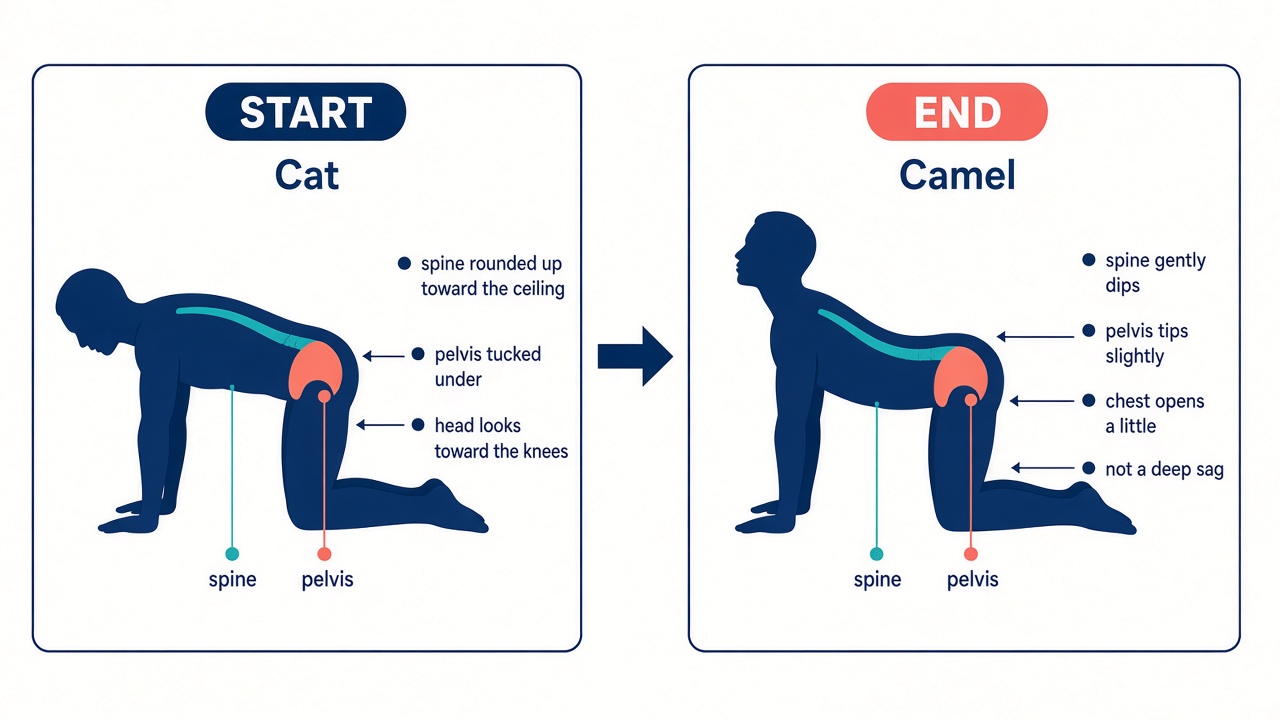
Cat-camel
Target: spine motion. This is a slow sweep, not a long hold and not a deep backbend.
Side view. Round, then a small dip. Stop the dip before the low back hangs.
Hands and knees, as in the bird dog start.
Exhale and round the whole spine, pelvis tucks, eyes toward the knees.
Inhale and let the spine return, then dip only a little. Chest opens slightly.
8 slow cycles. No bouncing.
Dose8 cycles. Easy.
Common mistakePushing the dip into a big arch because it “feels like a stretch.”
Open book
Target: mid-back rotation, lying down, so the low back is supported.
Lie on your side, knees bent and stacked, arms straight out in front.
Keep the knees together. Open the top arm across the chest until it rests toward the floor, or as far as the knees stay stacked.
Follow the hand with your eyes. Hold 3 breaths. Return. 5 times each side.
Dose5 × 3 breaths each side. Easy.
Common mistakeLetting the top knee lift and twist the low back instead of the ribs.
No drawing. Side or top view: knees stay together, only the top arm and chest open.
Optional hamstring, only if the hinge is limited
Target: back of the thigh, just enough to hinge with a long spine. Skip if the Romanian deadlift already feels tight in a useful way.
On your back. One knee bent, foot on the floor. Other leg up, strap or hands behind the thigh.
Keep that hip heavy on the mat. Straighten the knee only until 5/10.
Hold 20–30 seconds. Switch.
Hold20–30 seconds. Stop at 5/10.
Common mistakePulling the leg so far the pelvis rolls up and the low back flattens hard.
Calf, on run days
Target: calf. Running loads it every step. It does not fix pelvic tilt. It keeps the ankle from stealing range from the hip.
Hands on a wall. One foot back, heel down, toes forward.
Bend the front knee until the back calf feels 5–6/10. Knee of the back leg stays soft, not locked.
Hold 30 seconds. Switch. A second round with the back knee slightly bent shifts the stretch lower.
Hold30 seconds each side.
Common mistakeBack heel lifted, or the foot turned out.
C. Before and after running or tennis
Before, about 5 minutes. Raise temperature and rehearse positions. Long static holds are a poor warm-up. In novice runners, a stretch-only comparison lost to hip-and-core work.6
3 rib-down breaths, standing.
Leg swings, below, 10 each way each leg.
6 easy reverse lunges each leg, shallow, as in Section 1.
Start the run or the hit easy for the first few minutes. Do not open at race pace.
After, about 5 minutes. Walk 2–3 minutes, then half-kneeling hip flexor 30 seconds each side, supine or seated figure-4 30 seconds each side, calf 30 seconds each side, and 5 rib-down breaths.
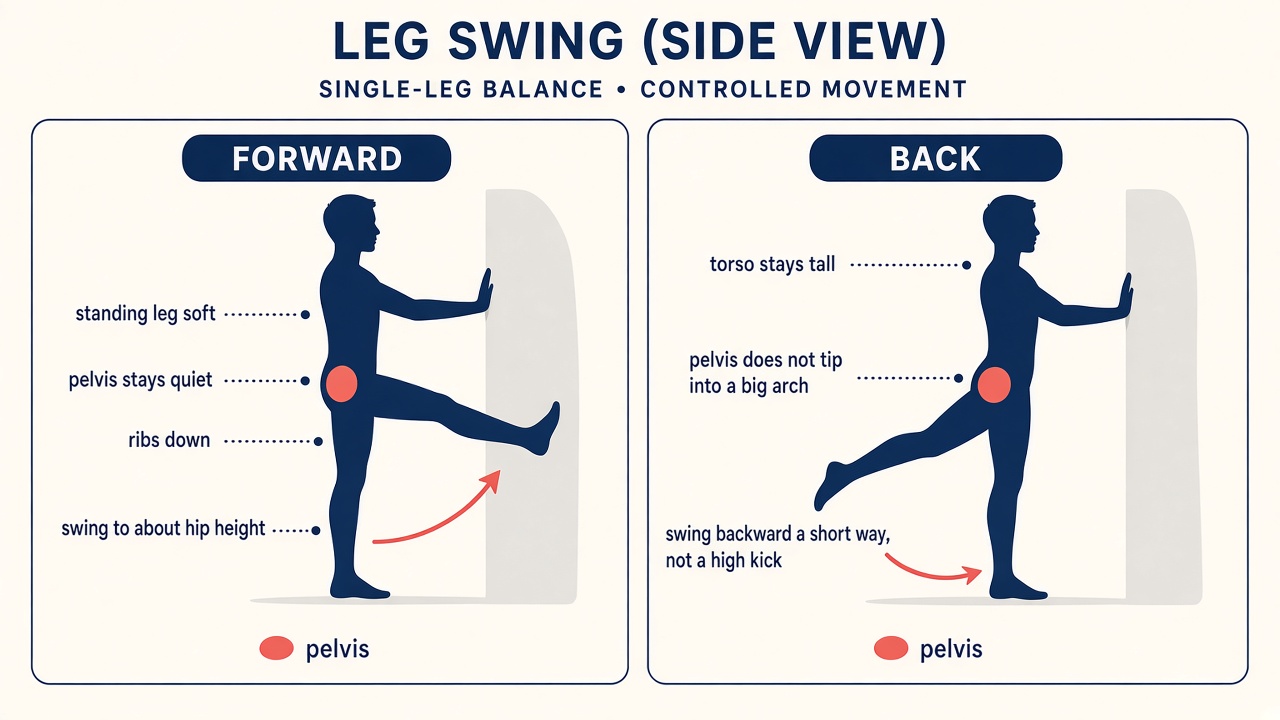
Leg swings
Target: hip motion for the run or the first few steps on court. The pelvis stays quiet.
Side view, hand on a wall or chair. Forward is about hip height, not a kick. Backward is short so the low back does not arch.
Stand tall on one leg. Ribs down. Soft standing knee.
Swing the free leg forward and back like a pendulum. 10 times.
Turn sideways to the support and swing across the body and out, smaller range, 10 times.
Switch legs.
Dose10 forward-back and 10 across, each leg. Easy speed.
Common mistakeArching to swing higher, or locking the standing knee.
Every 30–45 minutes at the desk
About 60–90 seconds. Stand up. The trial that improved young people’s back pain used a short active break at least every 30 minutes.11 A timer is the whole trick.
Stand. Unlock the knees.
5 rib-down breaths.
4 glute squeezes, 5 seconds each.
20–30 seconds of the standing hip-flexor shift on each side, or a walk to fill a glass of water if the hips feel fine.
If the low back already feels hot, take the break earlier. Do not wait for the timer. If a break makes pain spread into the leg, stop the stretch and use the red-flag list.
One-page daily checklist
Morning
Desk
Strength, 3 days this week
Run or tennis
Evening check
Red flags
Go to emergency care now if back or leg pain comes with any of these. Say the symptoms clearly at triage. These match NHS and NICE warning signs for cauda equina syndrome and serious spine problems.1617
New numbness or pins and needles between the inner thighs, around the genitals, buttocks, or back passage. A changed feeling when you wipe is included.
New trouble starting urine, stopping the stream, knowing when the bladder is full, or leaking.
New loss of bowel control, or not feeling a bowel movement.
A new change in sexual sensation, erection, or ejaculation.
Weakness in both legs, a leg that gives way, or a foot that drags.
Back pain with fever, or pain after a major fall or accident.
Book a doctor or physio soon. Do not spend the 8 weeks hoping these settle.
Pain, numbness, or pins and needles down the leg, especially below the knee.
Pain in both legs, or one-sided leg pain that becomes both sides.
Night pain that wakes you and does not ease when you change position.
Pain that is clearly worse week by week, or unexplained weight loss, a history of cancer, or feeling generally unwell.
You use steroids, have osteoporosis, and the pain followed even a small strain.
Sitting, running, or tennis is still sharply limited after 2–3 weeks of this plan and easier training loads.
Most low-back pain is not dangerous, and staying active is part of care.5 The list above is the exception. This guide does not tell you what your pain is.
Sources
Retrieved October 2026. Tiers: established = I would trust the direction; indicated = one good source or a real limit on who was studied; speculative = called out in the text, not used as a rule.
Laird RA, Gilbert J, Kent P, Keating JL. Comparing lumbo-pelvic kinematics in people with and without back pain: a systematic review and meta-analysis. BMC Musculoskelet Disord. 2014;15:229. Peer-reviewed. PMC4096432. No significant difference in usual standing pelvic tilt.
Sugavanam T, Sannasi R, Anand PA, Javia PA. Postural asymmetry in low back pain: a systematic review and meta-analysis of observational studies. Disabil Rehabil. Published online 21 Aug 2024. Peer-reviewed. 10.1080/09638288.2024.2385070. Small tilt difference, high heterogeneity, no firm conclusion.
Brekke AF, Overgaard S, Hróbjartsson A, Holsgaard-Larsen A. Non-surgical interventions for excessive anterior pelvic tilt in symptomatic and non-symptomatic adults: a systematic review. EFORT Open Rev. 2020;5(1):37-45. Peer-reviewed. 10.1302/2058-5241.5.190017. Very low certainty. Search ended March 2019. Later small trials do not close that gap.
Hayden JA, Ellis J, Ogilvie R, Malmivaara A, van Tulder MW. Exercise therapy for chronic low back pain. Cochrane Database Syst Rev. 2021;9:CD009790. Peer-reviewed. 10.1002/14651858.CD009790.pub2.
NICE. Low back pain and sciatica in over 16s: assessment and management. NG59. Published 2016, recommendations current, manual-therapy wording amended 2026. Official. nice.org.uk/guidance/ng59. Stay active, exercise to preference, no belts or foot orthotics for this purpose.
Leppänen M, Viiala J, Kaikkonen P, et al. Hip and core exercise programme prevents running-related overuse injuries in adult novice recreational runners: a three-arm randomised controlled trial (Run RCT). Br J Sports Med. 2024;58(13):722-732. Peer-reviewed. 10.1136/bjsports-2023-107926. Novice runners, supervised. Do not treat it as proof for every experienced runner.
Hall G, Barry G, Hayes P. The role of hip abductor strengthening and the effects on running gait: a systematic review. Adv Exerc Health Sci. 2025;2(1):16-23. Peer-reviewed. 10.1016/j.aehs.2025.02.004. Open access, CC BY-NC-ND. Strength rose; gait change was not shown.
González-de-la-Flor Á, Cotteret C, García-Pérez-de-Sevilla G, Domínguez-Balmaseda D, del-Blanco-Muñiz JÁ. Comparison of two different stretching strategies to improve hip extension mobility in healthy and active adults: a crossover clinical trial. BMC Musculoskelet Disord. 2024. Peer-reviewed. 10.1186/s12891-024-07988-9. Immediate effect, healthy adults, not a pain trial.
Hatefi M, Babakhani F, Ashrafizadeh M. The effect of static stretching exercises on hip range of motion, pain, and disability in patients with non-specific low back pain. J Exp Orthop. 2021;8:55. Peer-reviewed. 10.1186/s40634-021-00371-w. Group-by-time interaction was not significant. Women 25–40 only.
Watt JR, Jackson K, Franz JR, Dicharry J, Evans J, Kerrigan DC. Effect of a supervised hip flexor stretching program on gait in elderly individuals. PM&R. 2011;3(4):324-329. Peer-reviewed. 10.1016/j.pmrj.2010.11.012. ⚠️ Older adults, twice daily for 10 weeks. Not a desk-worker trial.
Labecka MK, Plandowska M, Truszczyńska-Baszak A, et al. Effects of the active break intervention on nonspecific low back pain among young people: a randomized controlled trial. BMC Musculoskelet Disord. 2024;25:1055. Peer-reviewed. 10.1186/s12891-024-08186-3. Ages 18–25, physical-education students.
Ghorbanpour A, Azghani MR, Taghipour M, Salahzadeh Z, Ghaderi F, Oskouei AE. Effects of McGill stabilization exercises and conventional physiotherapy on pain, functional disability and active back range of motion in patients with chronic non-specific low back pain. J Phys Ther Sci. 2018;30(4):481-485. Peer-reviewed. PMC5908986. n = 34. Both approaches helped.
Abbasi S, Mousavi SH, Khorramroo F. Association between lower limb alignment and low back pain: a systematic review with meta-analysis. PLOS One. 2024. Peer-reviewed. 10.1371/journal.pone.0311480. Mixed study quality. Not a reason to buy orthotics.
American College of Sports Medicine. Resistance training prescription for muscle function, hypertrophy, and physical performance in healthy adults: an overview of reviews. Position stand. Med Sci Sports Exerc. 2026. Official / peer-reviewed. PMC12965823. At least twice a week; bands and bodyweight count.
Garber CE, Blissmer B, Deschenes MR, et al. Quantity and quality of exercise for developing and maintaining cardiorespiratory, musculoskeletal, and neuromotor fitness in apparently healthy adults. Med Sci Sports Exerc. 2011;43(7):1334-1359. Official position stand. ⚠️ Published 2011. Flexibility dose used here (2–3 days a week, 10–30 second holds, tightness or slight discomfort). The 2026 stand updates strength, not this stretch paragraph.
NICE Clinical Knowledge Summaries. Sciatica: red flag symptoms and signs. Official. cks.nice.org.uk. Retrieved October 2026.
NHS Greater Glasgow and Clyde. Cauda equina syndrome: important warning signs. Official patient sheet. PDF. Retrieved October 2026. Also see the national suspected CES pathway, GIRFT, March 2026.
Figures
Drawings were generated for this guide: flat navy silhouette, coral pelvis, teal low back, start and end side by side. They are original teaching figures, not copied from a book, and not a clinical photo. A few need the written correction in the card (dead bug’s hidden arm, side plank on the forearm, hip-thrust weight on the hip bones, bird dog if a label looks swapped).
Photo references you can open, without copying the pictures into this file:
To redraw one figure: “Instructional flat vector, off-white background, two panels labelled START and END, navy adult silhouette, no face, coral pelvis, teal low back, one arrow, side view, high contrast, no extra limbs,” then the steps from that card.